
Archive
National research award
Tuesday, 29 Apr 2008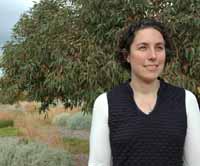 The importance of research into a major Australian agricultural and environmental weed - serrated tussock - has been acknowledged with a national scholarship awarded to Charles Sturt University (CSU) student, Ms Sonia Graham. The PhD student is one of two university students in Australia to be awarded the three year, $15 000 AW Howard Memorial Research Fellowship. Presented to the Canberra-based Ms Graham by AW Howard Memorial Trust chairman, Professor Rob Lewis, the fellowship will be used to assist with her research. Serrated tussock has spread across farming lands making large areas of NSW and Victoria unproductive. Ms Graham’s study looks at the ways farmers and State and local governments work together to control the weed. The AW Howard Memorial Research Fellowship commemorates the unique contribution of the late South Australian farmer, Mr Amos Howard, in the use of subterranean clover as a major pasture plant in Australia.
 Top academic honour for Eucalypt research
Tuesday, 29 Apr 2008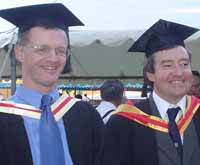 Outstanding academic performance by Charles Sturt University (CSU) graduate Mr David Waters for his research into the world’s tallest flowering plant, the Mountain Ash, has seen him receive the highly prized Charles Sturt University Medal. Mr Waters, from the NSW Department of Primary Industries in Wagga Wagga, was presented the medal while receiving his first class honours in his Bachelor of Applied Science (Environmental Horticulture). The medal allows CSU to give special recognition each year to graduates whose academic performances are “superlative”. Mr Waters’ research involved an anatomical examination of the epicormic structure of the Mountain Ash or Eucalyptus regnans. The species regenerates by seed after high intensity fire, in the mountainous regions of Victoria and Tasmania. Previously, there have been suggestions that its poor re-sprouting ability was due to a lack of epicormic buds that have been found in other eucalypts. However, the research proved conclusively that the species has an epicormic structure typical of other eucalypts. “David has provided a unique perspective on why Mountain Ash can resprout in some circumstances but not others,” said CSU senior lecturer and research supervisor, Dr Geoff Burrows.
 Waste recycling on display
Tuesday, 29 Apr 2008As part of its commitment to creating a sustainable future, Charles Sturt University (CSU) will open up its ‘Closed-Loop Organic Recycling System’ for public inspection in Wagga Wagga on Tuesday 6 May. The open day coincides with ‘International Composting Awareness Week’. Servicing 4 000 staff and students and maintaining 88 hectares of campus grounds, the system collects and processes organic materials from University facilities such as ovals, lawns, horse stalls, the Winery, catering, the CSU farm and offices. CSU’s Division of Facilities Management has worked with the Riverina Eastern Regional Organisation of Councils (REROC) to tackle issues of continual green waste management. “We’ve enabled CSU to become an example of best practice for managing organic waste,” said CSU’s Mr Will Pollack. “The program currently saves around 200 tonnes of waste going into landfill and this figure is continually growing as the program expands.”
Farmers take control
Tuesday, 22 Apr 2008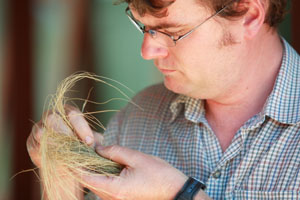 ‘Get tussock before tussock gets you’ is the topic of a free information session about the destructive weed. Charles Sturt University’s (CSU) Dr Aaron Simmons has been passionate about pest and weed control since beginning his PhD at the CSU’s Orange Campus in 2003. Now he and fellow associate Ms Linda Ayres, from the NSW Department of Primary Industries, will discuss with farmers the factors associated with successful serrated tussock control. Serrated tussock is regarded as one of the worst weeds in Australia’s agricultural areas. Because of its invasiveness, it spreads potential economic and environmental impacts costing Australia more than $55 million a year. The information session will be held from 8am to 10am on Tuesday 29 April in the hall at Euchareena, north of Orange. A free breakfast is available. RSVPs are essential. Contact Dr Aaron Simmons on 6365 7630 or send an email.
Success at the CAT Awards
Tuesday, 22 Apr 2008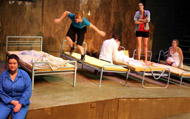 Charles Sturt University’s (CSU) theatrical collaboration with an acclaimed international playwright and director has resulted in double success for the University Theatre Ensemble (UTE) at the prestigious Canberra Area Theatre (CAT) Awards. Distinguished Russian director, Mr Leonid Verzub was named Best Director of a Play for his production of Stars in the Morning Sky, which ran at the Riverina Playhouse in Wagga Wagga in March 2007. Mr Verzub, who was awarded the title of Honoured Artist of Russia and Theatre Director of the Highest Category in 1979, was invited to CSU’s Wagga Wagga Campus by a former student Dr Ashley Wain, who is now a lecturer in acting in the CSU School of Visual and Performing Arts. Ms Liz Jenkinson, a CSU Design for Theatre and Television third year student who worked closely with Mr Verzub, was awarded Best Set Designer (Play).
 Celebrating a decade of educating health professionals
Tuesday, 22 Apr 2008Celebrating ten years of educating physiotherapists and speech pathologists at Charles Sturt University (CSU) will be combined with a ceremony in Albury this week to highlight the achievements of current students. The existing CSU students from the School of Community Health will receive recognition for their academic excellence through the Dean’s Awards. They will be presented by CSU’s Dean of Science, Professor Nick Klomp in a ceremony at CSU’s Albury City site on Wednesday 23 April. During the same ceremony, CSU Vice-Chancellor and President Professor Ian Goulter will join past and current staff and students to commemorate the start of the physiotherapy and speech pathology courses at CSU’s Albury-Wodonga Campus 10 years ago. Both courses have produced over 200 graduates each. More than 60 per cent of those graduates have commenced their professional careers in regional Australia, helping address the allied health professional skills shortage across Australia. Early CSU physiotherapy graduates now hold senior posts in Victorian and NSW health services and are also involved with elite sports teams such as the Matildas national women’s football team. Both ceremonies will be held in front of The Cedar, CSU, Olive St, Albury, between 10.30am and 12noon on Wednesday 23 April.
Wine and business acumen honoured
Thursday, 17 Apr 2008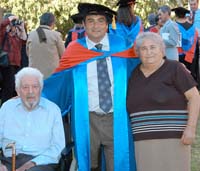 It was a family affair when Winemaker and Managing Director of Casella Wines, John Casella, was awarded an Honorary Doctor of Business by Charles Sturt University (CSU) in April 2008. Dr Casella received the doctorate in recognition of his contribution to the Australian wine industry, particularly through the creation of new export markets, the economic health of the Riverina region of NSW, and to wine education and research programs at CSU. Founded in 1969 by his parents, Filippo and Maria Casella, Casella Wines dramatically increased production under Dr Casella, who also oversaw the launch of the [yellow tail] brand into the United States in 2001. The [yellow tail] brand is the most successful launch of an Australian wine brand in the history of the Australian wine industry. In addition to praise of his management of the family business, Dr Casella was honoured for his commitment to developing the skills and capacity of young people in the Riverina. He attended the CSU graduation ceremony in Wagga Wagga with his parents, his wife and four children.
 Reviewing Aboriginal education
Tuesday, 8 Apr 2008The review of Aboriginal education across NSW three years ago will be scrutinised in a public lecture at Charles Sturt University’s (CSU) Dubbo Campus on Wednesday 9 April. Adjunct Professor in the CSU Faculty of Education, Alan Laughlin, will speak about the NSW Aboriginal Education Review of 2004, which was one of the widest assessments of the opinions of Aboriginal people carried out in NSW. “Three years on, many of the recommendations have been implemented. Clearly, generational change is needed, but what has been the impact to date?” Professor Laughlin asks. “The review involved over 400 meetings and more than 4 000 interviews with parents, teachers and students, and 200 oral and written submissions were received. A comprehensive set of recommendations was presented to the NSW government to improve outcomes for Aboriginal children.” Alan Laughlin was the Deputy Director General (DDG) of Education in the NSW Department of Education and Training. He has held every position from teacher through to the level of DDG in his 40 year career.
CSU lends hands to environment
Tuesday, 8 Apr 2008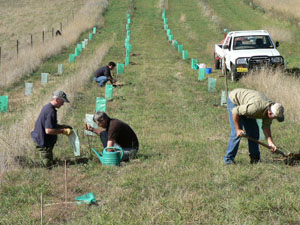 Staff at Charles Sturt University’s (CSU) Orange Campus rolled up their sleeves last week and planted over 200 trees as part of a biodiversity project coordinated by the Summer Hill Creekcare group near Orange, which received a grant from the Central West Catchment Management Authority. CSU land management lecturer and group coordinator, Ms Cilla Kinross, said the tree planters used a mixture of native species including Eucalypts, Wattles, Casuarina and nectar-producing shrubs grown from seed by University staff volunteers in the Orange Campus nursery facilities. “This second tree planting day was a great success,” said Ms Kinross. “Thanks to the local assistance, the site is now ‘complete’ – it is fenced and we planted 500 trees and shrubs. In fact, closer to 600 plants were put in over the two days and with some help from TAFE students as well.”
Equine centre back in business
Tuesday, 8 Apr 2008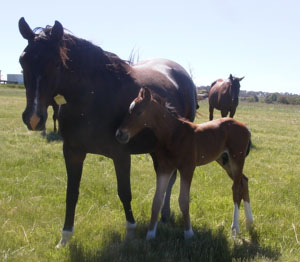 With the NSW equine industry given the all-clear following the outbreak of equine flu that threatened the national horse industry, Charles Sturt University’s (CSU) Equine Centre is back in business. Centre manager Ms Cheryl Gander is excited to have the Centre up and running again. “The Orange Campus Equine Centre provides the perfect location for students to be involved in all aspects of horse enterprise management, including breeding, training for different disciplines, show and sale preparation, different handling techniques and research,” Ms Gander said. The Centre, which is part of the School of Agricultural and Wine Sciences, has an indoor and outdoor arena, exercise track, cross country course, treadmill, horse walker, stables, veterinary laboratory and 80 hectares of horse pastures. For enquiries regarding agistment, breeding and facility hire, contact Ms Gander on 02 6365 7850.