
Archive
Monitoring the economic future of an historic town
Wednesday, 1 Jan 2003 Earlier this year Braidwood in the Southern Tablelands of NSW was listed on the State Heritage Register – the first town on the east coast of Australia to be recognised in this way. Now the residents will find out how Braidwood will be affected economically by the listing when the Western Research Institute (WRI) of Charles Sturt University begins its study to monitor the town’s future. Kathy Sloan, a senior research officer with the WRI says “the listing does restrict what can happen to buildings and what people can do on their properties. On the other hand, a heritage listing can be a good way to attract more tourists, and they already market themselves that way.” The study has commenced with an economic profile of Braidwood, including an analysis of the local economy. Once benchmarks are identified, a business survey will be conducted every year for five years. The WRI will then compare Braidwood’s economic trends with trends across regional NSW.
CSU lecturer returns from horse championships
Wednesday, 1 Jan 2003Charles Sturt University Rural Management lecturer, Sue Johnson, has returned from the Camden Equestrian Centre where she worked as the NSW Elite Horse Coach during the week-long Polocrosse Australian National Championships. A lecturer in Livestock Production and a passionate horse enthusiast, Sue jumped at the chance to be involved in this prestigious event. Held every two years, the Polocrosse Australian National Championships is attended by 400 players and 700 horses from around Australia, as well as over 7 500 spectators. Ms Johnson’s responsibilities included pre-competition checking that the horses were fit and prepared for the games. Polocrosse claims is a “truly Australian made sport” (along with AFL and campdrafting) being developed in Australia in the 1930s from a mix of polo, lacrosse and netball.
CSU features at National Field Days
Wednesday, 1 Jan 2003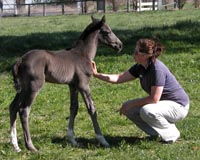 The CSU Orange Campus has traditionally had a strong affiliation with the Australian National Field Days (ANFD) which this year will be held at the Borenore site in Orange from 17-19 October. CSU’s Equine business management course coordinator Amanda Warren-Smith said as well as their usual stand at the ANFD, the CSU Equine Unit will also coordinate a new Equine Expo. She said horses are an employment intensive industry: “A lot of people don’t realise that the horse industry contributes $8 billion a year to Australia’s GDP. Our Equine Business management course looks into aspects such as breeding, racing, competing, the pleasure horse industry and horse therapy. To have students working on the Equine Expo at ANFD also gives them added exposure to the event management side of the industry.” Charles Sturt University will also have a CSU course and enterprises information stand at Field Days called Educating tomorrow’s professionals.
 Cambodian Prime Minister at Wagga Wagga CSU
Wednesday, 1 Jan 2003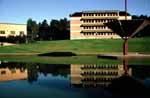 Samdech Hun Sen, Prime Minister of the Kingdom of Cambodia will inspect the Wagga Wagga Campus of Charles Sturt University (CSU) on Thursday 12 October. He will be accompanied by a large delegation from Cambodia, a country in Southeast Asia with a population of more than 13 million. Head of the University’s Wagga Wagga Campus Professor David Green says the Prime Minister is visiting Wagga Wagga as part of his official visit to Australia. “The Cambodian Prime Minister expressed an interest in seeing Australian agricultural facilities, hence the visit to our Campus.” Vice-Chancellor Professor Ian Goulter said “it is very clear that our model of collaboration with government agencies and with industry, as demonstrated with the E H Graham Centre and the National Wine and Grape Industry Centre, is a model for other countries to use.” The Cambodian delegation will be briefed on current collaborations between the NSW Department of Primary Industry and Cambodian research institutions before a luncheon hosted by CSU. Professor Deirdre Lemerle, Director of the E H Graham Centre for Agricultural Innovation, a joint research venture between CSU and the NSW Department of Primary Industries, says the visit is a “tremendous opportunity to showcase our excellent research capacity in agriculture, and further develop our collaborative links with Cambodia to create profitable and sustainable agricultural systems.”
Equine lecturer returns from International Symposium
Wednesday, 1 Jan 2003 It’s a long way from Milano, Italy to Borenore just outside Orange. Equine Business Management lecturer, Amanda Warren-Smith, has just returned from the second International Equitation Science Symposium which was held in Milano and explored the latest research in horse behaviour, training and welfare. Amanda’s paper at the symposium, An audit of the application of the principles of equitation science by qualified accredited equestrian instructors in Australia looked at whether accredited equestrian instructors in Australia have an understanding of the principles of learning theory. The symposium was attended by almost 200 delegates from all over the world. From there it was straight to the Australian National Field Days (ANFD), where Ms Warren-Smith is assisting in the coordination of the ANFD Equine Expo. The Expo gives Equine Business Management students a chance to use their event management skills as well as equestrian skills such as dressage and jumping acquired through their studies.
 A complementary agreement
Wednesday, 1 Jan 2003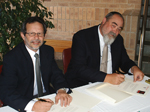 Charles Sturt University’s (CSU) Bachelor of Health Science (Complementary Medicine) has signed an articulation agreement with Workers Educational Association (WEA) Hunter. CSU’s Dean of the Faculty of Health, Professor Mark Burton, says “this is a significant industry partner. WEA Hunter run a variety of programs in vocational education including Advanced Diplomas in naturopathy, western herbal medicine and massage therapy.” Professor Burton explains that graduates from WEA Hunter can then join CSU and “upgrade to degree status by adding in a variety of CSU science based programs”. Ben Grushka, Executive Director of WEA Hunter, describes the agreement as “very important. It allows our graduates to project themselves into further education. We believe that once the word gets out, it will become very popular.”
India’s booming economy
Wednesday, 1 Jan 2003 Last year, for the first time, India passed China in economic growth, when India’s gross domestic product (GDP) grew by more than 8 per cent. The second quarter of 2006 saw a massive 8.9 per cent growth in the Indian economy. No wonder then that Charles Sturt University (CSU) will host a high profile seminar discussing trade between India and Australia tomorrow (18 October). Speakers such as Professor Kevin Parton, Head of School of Rural Management at CSU Orange will highlight future prospects for trade in areas ranging from agribusiness to minerals and service industries. “India certainly is becoming a much more important trade partner for Australia, with products such as coal, and in future probably uranium for important energy sources for the growing Indian economy. It is fairly obvious that India can provide us with IT and financial services”. India is also the guest nation at this year’s Australian National Field Days (ANFD) to be held in Orange from 17 October.
Apprenticeships a hot issue
Wednesday, 1 Jan 2003 Associate Professor Erica Smith from Charles Sturt University’s (CSU) Faculty of Education says “apprenticeships are such a hot issue at the moment”. This is why the topic has been chosen for the latest Research in Vocational Education and Training (RIVET) colloquium to be held at CSU this Friday (20 October). Professor Smith says the twice yearly events, which are funded by CSU’s Faculty of Education and managed by the RIVET CSU Community of Scholars, “have quite a reputation among the local community as a place to come and keep up to date with the latest research. The first speaker is looking at how to improve teaching practice in apprenticeships, and then we have a local speaker who is going to talk about the impact of recent national changes at a local level. The second part of the day is about innovations to increase participation in apprenticeships. School-based apprenticeships are new to NSW, and schools will learn how they can integrate these into their curriculum. The final paper is about pre-apprenticeships which is an initiative to start people in apprentice training off the job.”
 Seeking answers to nursing attrition rates
Wednesday, 1 Jan 2003According to a report published in March of this year, the well-documented nursing workforce shortage is an international problem. Nurse resignation rates in the USA are around 12-15 per cent per annum, while the annual attrition rates in New South Wales are closer to 20 per cent. Susan Bragg, a PhD student with the School of Health Science, is hoping to explore the reasons why NSW rural registered nurses resign from hospitals by interviewing nurses who resigned from a NSW rural hospital for reasons other than maternity, retirement or geographic relocation. “The idea came to me after I left the hospital system, and then we kept hearing about the nurse shortage. I wondered why no one was listening to the nurses who had resigned. I strongly believe that the nurses who have left the system hold the reason why. I think there are quite a few issues impacting on why nurses leave and hopefully I can summarise those in my thesis and then the system may pay attention.”
5 Nations cattle specialists visit CSU Vet Science facilities
Wednesday, 1 Jan 2003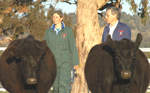 The world’s leading cattle producing nations visited Charles Sturt University’s (CSU) Veterinary Science Facilities as part of the 5 Nations Beef Conference being held this week. International delegates from the United States, Canada, Mexico, New Zealand and Argentina viewed CSU’s Veterinary Science facilities as part of their focus on the future of the cattle industry. The visit has further strengthened links between CSU and the Cattle Council of Australia. Director of Veterinary Science, Professor Kym Abbott said the Veterinary Pre-Clinical Centre gave the 30 delegates an insight into future global animal health management. “Cattle health is high on our agenda at CSU, because it is central to veterinary biosecurity and herd management as well as research into current and potential threats to Australia’s livestock industries.” Professor Abbott said it was an honour for CSU to be able to showcase “to leading cattle specialists from around the world what we are doing in Veterinary Science”. The Cattle Council of Australia will return to the University for the official opening of the new “state of the art” cattle yards and CSU Veterinary Science Foundation Dinner on Saturday 28 October. Cattle Council Executive Director, David Inall will be guest speaker at the Dinner.