
Archive
Book launched for the spoken word
Wednesday, 1 Jan 2003 An international book by a Charles Sturt University (CSU) academic about how children learn to speak will be launched on Thursday 26 April. Associate Professor Sharynne McLeod’s new International Guide to Speech Acquisition lists the components and phonetics of twelve English dialects and 26 other languages, making it the most comprehensive text of its kind. “The International Guide to Speech Acquisition describes the process by which children learn different dialects and different languages. Some of the information has never been translated into English before. If an English-speaking child has a Norwegian mother and a Filipino father, and they are having difficulty in all three languages, this guide can assist the speech pathologist or teacher to help the child.”
Improving speech pathology services to the young
Wednesday, 1 Jan 2003A partnership between Albury-Wodonga’s Cooinda Family Support Group and the speech pathology course in Charles Sturt University’s (CSU) School of Community Health will see 19 families from the Border region receive individual assistance for their children’s speech development needs. The community project will see third year speech pathology students work closely with the families and program supervisor Dr Carl Parsons, who is a senior speech pathologist and patron of the Down’s Syndrome Association of Victoria. Dr Parsons is concerned at the shortage of speech pathologists working in regional Australia. “Families should not feel isolated due to their rural and regional situation,” he said. Dr Parsons will speak with the CSU students between 11am and 12.30pm today, Monday 30 April in Nowik Lecture Room 2 at Charles Sturt University, Guinea St, Albury, followed by participating families at 1pm. During this time, students will meet the families they will work with from May to November 2007.
Domestic violence stereotypes
Wednesday, 1 Jan 2003A Charles Sturt University (CSU) researcher says the Australian public is still clinging to damaging stereotypes in regards to the victims of domestic violence, despite public campaigns such as the Federal Government’s Violence Against Women Australia Says No. Trea Sanson-Fisher will be awarded her doctorate about public perceptions of domestic violence at CSU’s Bathurst graduation on Friday 11 May. She says although her community interviewees was more likely than the judicial system to recommend jailing the perpetrator, the interviewees thought the victim was partly responsible for the domestic violence if she had been drinking. Ms Sanson-Fisher added, “However, when the violence was severe and required a trip to hospital, the sample would ‘let go’ of a lot of stereotypes. It seems society is getting the message about severe domestic violence, but not quite getting the message about a slap or a push.”
CSU wine a top drop
Wednesday, 1 Jan 2003 Charles Sturt University (CSU) Winery has won a Blue-Gold Award at the recent Sydney International Wine Competition for its 2004 Limited Release Cabernet Sauvignon Merlot, which was also named in the Top 100 Wines of the Competition. Wine Judge Kym Milne rated the CSU wine, produced from Hilltop grapes at the CSU Wagga Wagga Winery, as having very complex aromas and a very elegant palate. Mr Milne agreed with another judge, Robin Moody, who said the medium bodied dry red was a big wine that went well with food. CSU head winemaker Andrew Drumm said he was particularly pleased with the last comment as this was always one of his aims. CSU Winery’s 2003 Limited Release Cabernet Sauvignon has already won numerous awards but Mr Drumm believes 2004 Limited Release Cabernet Sauvignon Merlot is a better wine. He believes the much sought after Blue-Gold Award is testament that CSU students are learning practices that are sought after within the Australian wine industry.
 International view on rural women’s networks
Wednesday, 1 Jan 2003 An international perspective on the value of networks for rural women will be presented at a public seminar at Charles Sturt University (CSU) on Thursday 3 May. The University’s Institute for Land, Water and Society will host Professor Carolyn Sachs from Pennsylvania State University in USA, who is an expert in sustainable agriculture, farm women’s networks and the impact of government policy on rural women. The Institute’s Professor Margaret Alston said Professor Sachs will offer an international perspective on the importance of rural women’s networks. “Professor Sachs’ work is internationally recognised,” Professor Alston said. “She comes to us from Rome where she has spent three months working in the United Nation’s Food and Agricultural Organisation. She will speak on issues that also affect Australian rural women during drought and in a period of great change in the industry.” The free public seminar will start at 4.30pm on Thursday 3 May in Nowik Auditorium, Guinea St, Albury.
Grey water reuse project "unique"
Wednesday, 1 Jan 2003 Charles Sturt University (CSU) and Bathurst Regional Council (BRC) hope to join forces on a grey water project which “will put Bathurst on the map as a leading water conservation city,” according to CSU research fellow Mr Daryl McGregor. The project will see 200 Bathurst homes fitted with a variety of grey water reuse treatment systems. “In partnership with BRC, CSU will take samples of what goes in the treatment plants and what comes out,” Mr McGregor explained. “We will measure power usage for pumps and how much cleaning and maintenance are required, while the treatment efficiency will be measured by laboratory analysis.” The subsequent recommendations could benefit people around Australia, says BRC’s manager of waste and water authority, Mr David Swan. “In the first instance, we are doing it in Bathurst but there is a wider application as well.”
Age shall not weary
Wednesday, 1 Jan 2003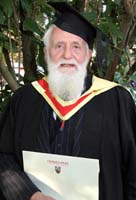 Proving age is no barrier when it comes to further education, Ian Findlay’s thirst for knowledge has seen him earn his fourth university degree at the age of 81. Mr Findlay graduated from Charles Sturt University (CSU) with a Master of Systems Development from the Faculty of Science and Agriculture on Friday 20 April. Seventy years after starting school, Mr Findlay decided to further his studies through the CSU distance education program after being impressed by CSU’s “fabulous reputation and wonderful library”. He already had a Bachelor of Arts, a Bachelor of Engineering and a post graduate diploma in Computing Science. Mr Findlay says, “university studies keep my head together; I like to know things”. At this stage he doesn’t intend beginning a fifth university degree, but says his research will continue. CSU’s oldest graduand is Elizabeth Brown who was 82 when she graduated in June 2003 with a Graduate Diploma in Ageing and Pastoral Studies.
The birth of passion
Wednesday, 1 Jan 2003 “At what point did people start to talk about sporting defeats as terrible tragedies, and wins as glorious triumphs?” In his seminar The Birth of Passion, Charles Sturt University’s (CSU) Dr Michael Gard asks, in modern sport, do highly paid players need to demonstrate their “passion” for sport in ever-more overt ways because, if they didn't, it would be more difficult for us “mere mortals” to overlook the huge sums of money players are paid? “Sport has become a bigger and bigger business. It is a self-fulfilling prophecy. People get swept along with it; suddenly they really do think it is important whether or not Federer wins the French Open, and if he does, you have people dancing in the street. And the players, instead of just shaking their opponent’s hand, are prostrate on the ground. The displays of emotion have changed dramatically over time.”
Orange soccer team kicking goals
Wednesday, 1 Jan 2003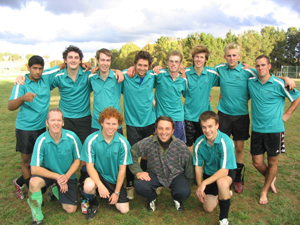 As many universities embrace a closer association with the social aspect of student lives, due to voluntary student unionism introduced last year by the Federal government, Charles Sturt University (CSU) has helped establish the Orange Campus’ first soccer team, who won their debut game last weekend. CSU Rangers, a new team in the local Division One soccer competition, made a bright start to their season with a 1 – 0 win over last season’s semi-finalists, Kinross Wolaroi. Team member and third year Pharmacy student Tim Denham was thrilled with the outcome. “Considering we only had one training session and no trial games, we did pretty well. It’s great to have another sporting option at the Campus and with both Pharmacy and Rural Management students in the team and it’s a good way to meet some new people.”
Farmers key to serrated tussock control
Wednesday, 1 Jan 2003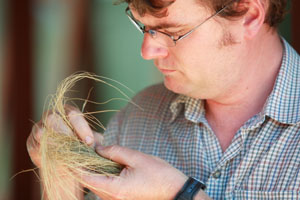 A Charles Sturt University (CSU) research team, funded by Land and Water Australia, believe they know where the key to successful serrated tussock control in native pastures can be found - in the people most affected by this weed, farmers. “A weed of national significance, serrated tussock covers more than one million hectares in NSW alone and impacts on the ability of farmers to make a living,” researcher Dr Aaron Simmons explains. “There are no concrete figures on how much land in the greater Bathurst area is infested but there are infestations around Turondale, Hill End, Rockley and Trunkey Creek.” Some farmers have been able to control this devastating weed whilst others have struggled. Although the CSU research team have interviewed many farmers in the district they are looking for more. Dr Aaron Simmons explains, “We want to interview around 80 people, or 40 sites, for this project and we are halfway there. Any further sites that could be found would be greatly appreciated”.