
Archive
CSU plants a thousand trees
Wednesday, 1 Jan 2003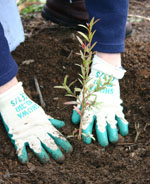 Thousands of native trees and shrubs will be planted on Charles Sturt University (CSU) campuses as its staff and students help mark National Tree Day. CSU Green, in collaboration with the Slopes to Summit partnership, has organised for around 1 000 native trees, shrubs and grasses to be planted on the University’s Thurgoona site on Friday morning 29 July by nearly 50 students and staff from nearby Trinity College. CSU has set targets of using 10 per cent of University land to increase biodiversity by 2011, and 20 per cent by 2015. CSU Green communication and education officer, Ms Nicole Maher said it is a practical way for people to make a difference to the local environment. “It’s really satisfying to walk past the site in the months and years that follow, and watch the plants you put in growing into a beautiful natural area,” she said. “By getting involved in something like this, people get a far greater appreciation for the incredible native flora and fauna that we have right here on our campuses.”
Solitude recaptured
Wednesday, 1 Jan 2003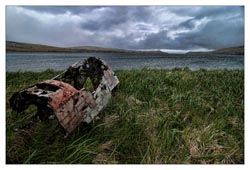 The solitude of US servicemen serving in the Aleutian Islands off the Alaskan and Russian coasts are seen in 24 arresting images of war depicting the Kiska battlefield through the lens of US master craftsman and artist Mr Sam Maloof. These have also been re-visited by contemporary artist and Charles Sturt University (CSU) academic Associate Professor Dirk Spennemann in 24 corresponding photographs. The exhibition, titled Solitude Recaptured opened on 23 July at March Field Air Museum at Riverside, California, USA. “While Sam Maloof is well known as a master craftsman of fine mid-century furniture, this exhibition shows he already had an ‘artist’s eye’ when he was a young soldier,” Professor Spennemann said. “It was a great opportunity to ‘re-vision’ Kiska 60 years later and to exhibit alongside Maloof’s images”. This travelling exhibit was developed by the US National Park Service Alaska Regional Office, The Aleutian WW II National Historic Area and CSU. The exhibit runs until Saturday 3 December.
Dramatic changes for learning climate
Wednesday, 1 Jan 2003University teaching in the 21st century is changing dramatically, and on Wednesday 27 July the Flexible Learning Institute (FLI) at Charles Sturt University (CSU) in Bathurst will launch initiatives to inspire best practice in blended and flexible learning (BFL) at the University. Professor of Higher Education and FLI director, Professor Mike Keppell, said, “Learning and teaching opportunities of the digital age are almost limitless, and these initiatives will help CSU course teams develop an integrated strategy to ensure best practice in blended and flexible learning across their whole course to ensure our students are well prepared for professional life. Charles Sturt University students now interact with national and international experts in ‘Second Life’, a free, 3D virtual world. They practice skills in simulations, diagnosing diseases using virtual microscopes, reflecting deeply about climate change in their blogs, and developing rich and engaging records of their progress from novice to emerging professional in their ePortfolios. We aim to create a comprehensive, integrated strategy to ensure that students gain a seamless experience across their courses, and are gradually immersed into these new professional worlds.”
Water, drought and climate change
Wednesday, 1 Jan 2003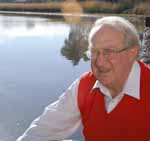 The environment will be under the microscope at a free public lecture to be held at Charles Sturt University (CSU) in Dubbo on Wednesday 10 August. CSU Adjunct Professor David Mitchell from the School of Environmental Sciences will tackle growing concerns about possibly profound changes in climatic conditions and their potential to undermine many strategies already developed to sustain agriculture for domestic consumption and export. “Australia is not alone in these concerns,” Professor Mitchell says, “but we have the benefits of a relatively low population density, which will help us adjust to changes in a climate that is already highly variable.” Professor Mitchell’s lecture will also discuss water resource management and agricultural sustainability.
Naomi short-listed for Australian meat judging team
Wednesday, 1 Jan 2003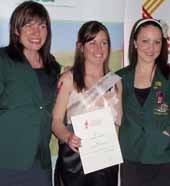 An animal science student at Charles Sturt University (CSU) in Wagga Wagga has been named as a finalist in a national meat judging competition. Seven agricultural, animal and veterinary science students represented CSU at the annual Intercollegiate Meat Judging (ICMJ) competition in Armidale from Tuesday 5 to Saturday 9 July. During the grading of beef, lamb and pork carcases and retail cuts, the CSU side competed with teams from other Australian universities as well as top teams from USA and Japan. “This provided an excellent opportunity for Charles Sturt University students to network with students from other universities interested in the production of high quality meat to the domestic and export markets,” said lecturer in animal production with the School of Animal and Veterinary Sciences, Dr Belinda King. Two of the seven CSU students made it into the final round. “However, after an excellent oral presentation, Ms Naomi Hobson was one of the 10 students named as finalists and selected for further training with Meat Standards Australia. She now can win a place in the Australian team to complete in the ICMJ competition in USA in January 2012.”
Reproduction theme of beef field day
Wednesday, 1 Jan 2003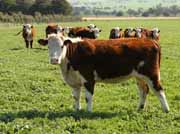 On a well-stocked property, heifer management drives profitability. This will be a key message during the Annual Graham Centre Beef Field Day in Wagga Wagga on Thursday 4 August from Dr Colin Scrivener from the Fred Morley Unit in the School of Animal and Veterinary Sciences at Charles Sturt University (CSU). “There are three basic rules producers need to follow when looking at the management of their cow herd: high heifer retention rates, adequate nutrition prior to puberty and management of dystocia,” said Dr Scrivener. “These ‘rules’ can be optimised through management. Other important things to consider include short joining periods, bull health, spring versus autumn calving, weaning systems and age at sale.” Dr Scrivener is one of many industry experts addressing the field day, which is organised by the EH Graham Centre for Agricultural Innovation – an alliance of CSU and the NSW Department of Primary Industries. The theme for this year’s event is reproduction. Read more about the field day here.
CSU plants thousands of trees
Wednesday, 1 Jan 2003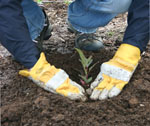 Thousands of native trees and shrubs will be planted at Charles Sturt University (CSU) as staff and students help mark National Tree Day. CSU Green has organised for native trees, shrubs and grasses to be planted at CSU in Bathurst on Friday 29 July, in Wagga Wagga on Saturday 30 July and in Orange on Thursday 18 August. CSU has set a target of using 10 per cent of University land to increase biodiversity by 2011, and 20 per cent by 2015. CSU Green communication and education officer, Ms Nicole Maher said it is a practical way for people to make a difference to the local environment. “It’s really satisfying to walk past the site in the months and years that follow, and watch the plants you put in growing into a beautiful natural area,” she said. “By getting involved in something like this, people get a far greater appreciation for the incredible native flora and fauna that we have right here on our campuses.”
Stories of the fall
Wednesday, 1 Jan 2003If you are over 65 and you have had a fall in that past 12 months, or are a relative or friend of someone who has, you can take part in research at Charles Sturt University (CSU) that looks at your experiences related to the fall. Ms Kristy Robson, a podiatry academic with the CSU’s School of Community Health and Centre for Inland Health is looking for participants specifically from Albury, Corowa, Wagga Wagga, Griffith, Coleambally, Boorowa, Young and Moama as part of her PhD research project. Ms Robson, who is based in Albury, said it is estimated that between 30 and 60 per cent of older people living in the community will experience a fall each year. “It is therefore important we try and understand why this is occurring, particularly for people living in inland communities of Australia. Most current research is based on the opinions of health experts. We want to collect stories from diverse inland communities which have widely spread people and health services. Programs developed for metropolitan situations might not be appropriate for our regional communities.” To participate in the CSU research project, contact Ms Wendy Rose Davison on telephone (02) 6051 9232.
Planning for better health in Rural Australia
Wednesday, 1 Jan 2003 Accessibility and human rights instead of rigid funding should be the priorities when planning health care services for rural and remote Australia, says Charles Sturt University’s (CSU) Professor of Rural and Remote Pharmacy Patrick Ball. Professor Ball studied four communities in central west NSW as part of his examination of the provision of health services outside metropolitan Australia. “Governments have put forward centrally controlled, standardised solutions based on defined services and bricks and mortar,” he said. “We have evidence to show that rural and remote areas need more flexibility in allowing individual communities to meet their health needs and more emphasis on access to services rather than what hospital and which health facilities are located where.” Professor Patrick Ball will present a free public lecture on his research from 6pm in West Wyalong on Wednesday 3 August.
International view of managing water resources
Wednesday, 1 Jan 2003Scientists and administrators from India are visiting the Border this week to investigate how Australia is managing the often conflicting uses for limited water resources. Charles Sturt University’s (CSU) Institute for Land, Water and Society is hosting the 14 person group, from Loktak in Manipur state and Chilika, Bhubaneswar, for their three-day visit to CSU in Albury-Wodonga and its surrounding natural and artificial wetlands. ILWS director, Professor Max Finlayson, said, “Indian wetland managers face competing interests for water resources, such as hydro-electricity, irrigation, domestic supply, and the environment, which we are also addressing in the Murray Darling Basin. This is a great opportunity for both countries to learn how we can more effectively manage our water resources for all our users.”