
Archive
Breeding lavender in the Riverina
Wednesday, 1 Jan 2003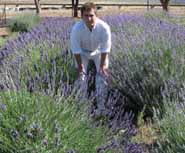 Known for their visual and sensual appeal, lavenders have been grown for centuries in the garden and commercially for their essential oils. A free public lecture in Tumbarumba on Wednesday 7 September will introduce some of the 39 species and many hybrids of lavenders. Since 2002 Dr Nigel Urwin from the School of Animal and Veterinary Sciences at CSU in Wagga Wagga has bred high yielding lavenders better suited to the Australian environment. His research, sponsored by the Rural Industries Research and Development Corporation and Larkman Nurseries, has produced some novel plants, including the world’s first commercially available ‘polyploid’ lavenders for farm and garden, and led to some interesting insights into the biology of lavenders. The lecture Breeding Lavenders in the Riverina for Farm and Garden will be held from 6pm in the Tumbarumba Shire Council Chambers in Bridge Street, Tumbarumba. CSU wine and cheese will be served after the lecture. Read more about Dr Urwin’s research here.
Farm manager jumps the fence
Wednesday, 1 Jan 2003Charles Sturt University (CSU) farm manager, Mr Steve Mannix, will close the farm gate for the last time on Friday 26 August after 17 years of working on the Orange Campus. Having studied an advanced diploma in horse management in 1990, Mr Mannix returned to the campus to lecture in equine studies in 1993. He then became the Manager at the campus equine centre before taking the role as farm manager in 1999. Mr Mannix leaves his position to concentrate on his equine business, Kintail Equine Services. “I have some great memories at the Orange Campus,” Mr Mannix said. “It’s where I met my wife who is also my business partner, and I’ve really loved working with the people and animals here. The student participation on the farm has been great, too.” Head of Campus, Dr Heather Robinson says Mr Mannix has contributed enormously to the campus. “Holistic management has been a key factor in the success of the business even through the toughest droughts, and Steve has worked hard to ensure the farm’s ongoing profitability. Steve’s also a wonderful personality on the campus. I wish him the best of luck in his future endeavours.”
Top teaching effort awarded
Wednesday, 1 Jan 2003The development of a way to teach distance education medical science students how to study normal and diseased human tissue with a virtual microscope has landed a teaching award for a Charles Sturt University (CSU) academic. Dr Lucy Webster, from the School of Biomedical Sciences at CSU in Wagga Wagga, has been awarded the 2011 Vice-Chancellor’s Award for Teaching Excellence. “The most important teaching strategies I employ to inspire and motivate students to learn include creation of interactive and engaging resources and demonstrating a true passion and expert knowledge in my field,” said Dr Webster. “Virtual microscopy enables the digital reproduction of glass slides containing healthy and diseased human tissues. Students are able to view and manipulate these images at remote locations. I combined this technology with the University’s real-time virtual classroom known as Wimba to allow genuine interaction between myself and the students to discuss the important features on each slide without having to be in the same room. Before this initiative, internal and distance education students could only view slides during practical classes or residential schools.”
Should we tax the sedentary?
Wednesday, 1 Jan 2003Links between sedentary and unhealthy lifestyles, some forms of diseases such as diabetes and obesity, and whether your neighbour should pay part of your health care will challenge the audience of a public lecture at Charles Sturt University (CSU) in Bathurst on Wednesday 31 August. Recently appointed Professor of Exercise Science and acting Head of CSU’s School of Human Movement Studies in Bathurst, Professor Robert Robergs, will deliver his first major lecture as part of the annual CSU Education Faculty forum. Professor Robergs’s lecture, titled The exercise and disease prevention dilemma: what we know but choose to ignore, will explore past studies of the causes of sedentary lifestyle diseases and the importance of physical activity and fitness in disease prevention. “We know that being physically fit, regardless of age, is essential for helping prevent disease,” Professor Robergs said. “There are barriers to developing an active lifestyle, and behaviour change is not just about medical and physiological knowledge. Central to this challenge is the responsibility of a citizen in a liberal social democracy. Does being sedentary increase risk and health care costs, like not wearing a seat belt when driving a car? If so, should we tax the sedentary? Why is it against the law to serve someone too much alcohol, but not too much food?”
Recreating violent crime aids learning
Wednesday, 1 Jan 2003Two major crime scenes of violent domestic assaults will be investigated at Charles Sturt University (CSU) in Wagga Wagga on Thursday 25 August all in the name of teaching and learning. The investigators at the two scenes will be students studying the subject Crime Scene by distance education. The assault victims and offenders will be played by Bachelor of Arts (Acting for Screen and Stage) at CSU in Wagga Wagga. “There is a single opportunity to process a crime scene in real life,” said Mr Pieter Strik, a lecturer with CSU’s Faculty of Arts. “Once an investigator has set foot on the crime scene it has been changed forever. There are no second chances so it is crucial appropriate processes are followed. This subject provides our students with the skills to detect, collect and preserve physical evidence,” said Mr Strik, who has had 30 years experience as a police officer including as a crime scene investigator. About 20 students will be involved in the scenarios from 1pm to 5pm near car park 4, Tooma Way at CSU in Wagga Wagga.
Grassroots projects to make CSU more sustainable
Wednesday, 1 Jan 2003From rainwater harvesting, to student vegetable gardens, fauna friendly fencing and biodegradable coffee cups, Charles Sturt University (CSU) is funding innovative projects to reduce its environmental footprint. In 2011, CSU Green has allocated almost
Jenna looks sharp
Wednesday, 1 Jan 2003 Charles Sturt University (CSU) staff member, Ms Jenna Sharp, will be presented with two significant awards by the Vice-Chancellor of CSU this week, adding to her impressive collection. The School of Biomedical Sciences administration assistant, Jenna recalls her year of success began when she convened the annual CSU administration conference, Admin Focus, for which guest speaker Ms Mary Brell nominated Ms Sharp for a Rotary Young Leadership Award. Ms Sharp went on to win the Orange City Council Youth of the Month award in June, and will now receive $6 000 as part of the award for performance excellence through the CSU Faculty of Science Award and CSU Vice-Chancellor’s Award. “I’m really excited to be receiving these awards,” Ms Sharp said. “I enjoy my job immensely and to be acknowledged for my work is very encouraging.” Ms Sharp is studying a Bachelor of Business (Marketing) degree full-time through CSU. “The money I receive for these awards is going straight to my university fees so I’m thankful for all the support CSU has given me.”
CSU Vice-Chancellors Awards for Excellence
Wednesday, 1 Jan 2003The annual Charles Sturt University (CSU) Vice-Chancellor’s Awards for Excellence will be presented at a ceremony at the University in Bathurst on Monday 5 September. The Vice-Chancellor and President of CSU, Professor Ian Goulter, said, “The 2011 Vice-Chancellor’s Awards for Excellence acknowledge the commitment, dedication and ongoing excellence demonstrated by both academic and professional staff across Charles Sturt University. I thank the award recipients for their efforts which collectively contribute to the continued success of the University.” The ceremony will start at 1pm at the James Hardie Room, Centre for Professional Development (S17) atCSU, Panorama Ave, Bathurst. A ceremony for the presentation of awards to CSU staff at its southern campuses was held on Monday 29 August.
Science in the Bush visits Orange
Wednesday, 1 Jan 2003Orange primary and high school students will get an insight into science and science careers during Science in the Bush Orange, at Charles Sturt University (CSU) on Friday 2 September. While attending workshops, shows, talks, and the popular Science in the Bush Expo students will use environmental sensors and basic programming to find out how robots work and will watch a laser light show to demonstrate how lasers work. Program coordinator, Ms Catherine Beehag, says, “Science in the Bush is a unique opportunity for school students to engage with scientific ideas that capture their imagination, whether it’s the Charles Sturt University’s Delving Under Your Skin workshop, or the Australian Museum’s Mini-Beasts Magnified”. “The whole program picks up on the recognition that in Australia we must do more to interest kids in science,” says Dean of Science at CSU, Professor Nick Klomp. “We want them to feel the excitement of science and discovery so we can produce our fair share of scientists in inland Australia.” The program has 90 different timetabled activities over two days, and involves local and national scientific organisations.
Exploring how chemistry changed the course of history
Wednesday, 1 Jan 2003In recognition of the 2011 'International Year of Chemistry', a public lecture hosted by Charles Sturt University (CSU) and Wagga Wagga City Council will explore how a series of seemingly unrelated chemical discoveries changed the course of history. Professor of Chemistry at Macquarie University in Sydney, Peter Karuso, will trace chemical connections from the humble shipworm to the discovery of antibiotics. "I'm hoping to show people how important chemistry is to their lives by showing how chemical discoveries have changed the course of history over and over again," he said. "Chemistry is so interesting and so powerful that it deserves the best and brightest minds. I hope in some small way to inspire young people and their parents to take an interest in things chemical as I am sure that chemistry will be at the heart of solutions to many of our current and future problems."