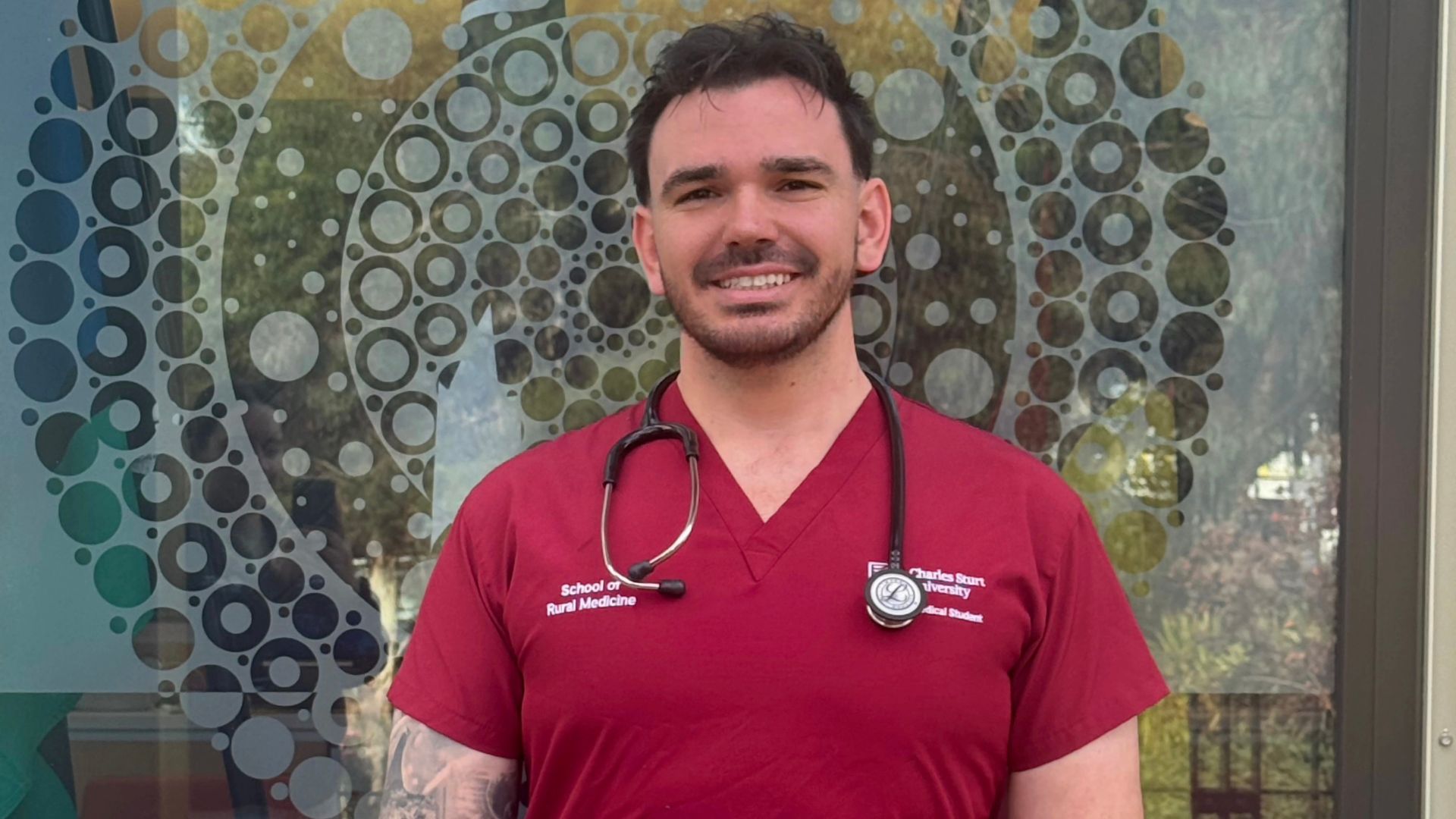
- First-year Medicine student Mr Ricky Worland used Charles Sturt’s alternative pathways into study to pursue his dream career in health
- Ricky went from working on the family farm near Lake Cargelligo to studying medicine at Charles Sturt in Orange
- More than 80 per cent of Charles Sturt’s first graduated cohort of medicine students commenced their careers in rural or regional practice this year
Going from working on his family’s farm to embarking on a medicine degree, Charles Sturt University student Mr Ricky Worland is proof that it’s never too late to rewrite your future.
After finishing high school without the marks typically required for entry into a health degree, the 29-year-old believed his dream career in medicine was probably out of reach.
“I always felt that working in healthcare, helping people through some of the worst days of their lives, would be the most meaningful career I could pursue,” he said.
“But for a long time, I didn’t think I was capable of getting there.”
Now a first-year Bachelor of Clinical Science (Medicine)/Doctor of Medicine student, Ricky’s journey to training to become a doctor is unconventional and inspirational.
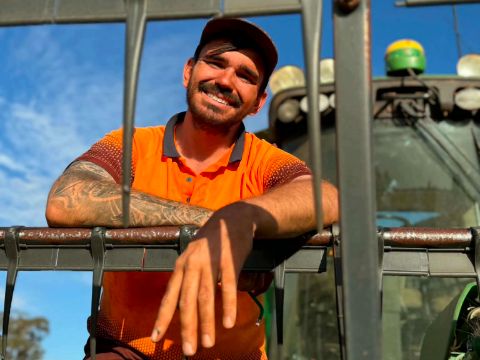 Ricky was working on a mixed farming property between Lake Cargelligo and Tullibigeal in regional NSW, where his family has farmed for four generations. While he found fulfilment in that work, the ambition to help others by becoming a doctor never disappeared.
He began studying the Undergraduate Health Certificate at Charles Sturt to build a grade point average strong enough to enter paramedicine. As part of those studies, he attended an intensive course and interacted with people aspiring to study medicine.
“Being surrounded by people chasing the same goal inspired me to stop viewing medicine as something impossible or unattainable,” he said.
“When I returned home, my confidence continued to grow with the support of my wife, and I made the decision to fully commit myself academically in a way I never thought I was capable of.”
After years of gruelling farm work, Ricky said studying medicine at Charles Sturt in Orange is the busiest - and most fulfilled - he has felt in his life.
“It is still a challenge, one I would recommend others not take lightly either,” he said.
“If I was to sum it up, I would say it is a great privilege to pursue something you genuinely love, even when it can push you to your limits.”
Ricky said that both farming and medicine are humbling careers. He believes farming shows that no matter how hard you work, you are still at the mercy of drought, storms, markets and seasons. Medicine carries similar lessons in that you can work endlessly and care deeply for people yet still be reminded how fragile and unpredictable life can be.
Ricky said he likely would not be pursuing his dream if it was not for Charles Sturt giving him the opportunity to prove himself. He said most universities would have overlooked him but Charles Sturt recognised the value of his farming background, his connection to rural communities and his volunteer and community involvement.
“Charles Sturt looked beyond grades alone and considered the type of person I was, along with my potential to become a good clinical practitioner, rather than whether I had come from a prestigious private school with perfect marks,” he said.
“What stands out most to me about Charles Sturt is that it genuinely tries to give people an opportunity, regardless of age, socioeconomic background or past setbacks.
“I think that approach is incredibly important, especially when it comes to training doctors for rural and regional communities.”
The Department of Health and Aged Care has identified a shortfall of GPs, with 7,700 needed by 2033 and almost 5,000 more needed by 2048. Approximately 20 per cent of Australians in remote areas do not have access to GP services.
More than 80 per cent of Charles Sturt’s first graduated cohort of medicine students commenced their careers in rural or regional practice this year.
“Rural communities understand hardship, but they also understand how important it is to show up for one another when times are difficult,” Ricky said.
“To me, medicine is simply another extension of that same idea. It is not just about science or prestige, but about service, trust and being willing to stand beside people during the moments they need it most.”
Applications for the next year’s intake of medicine students is now open and closes on Friday 25 September.

Social
Explore the world of social