
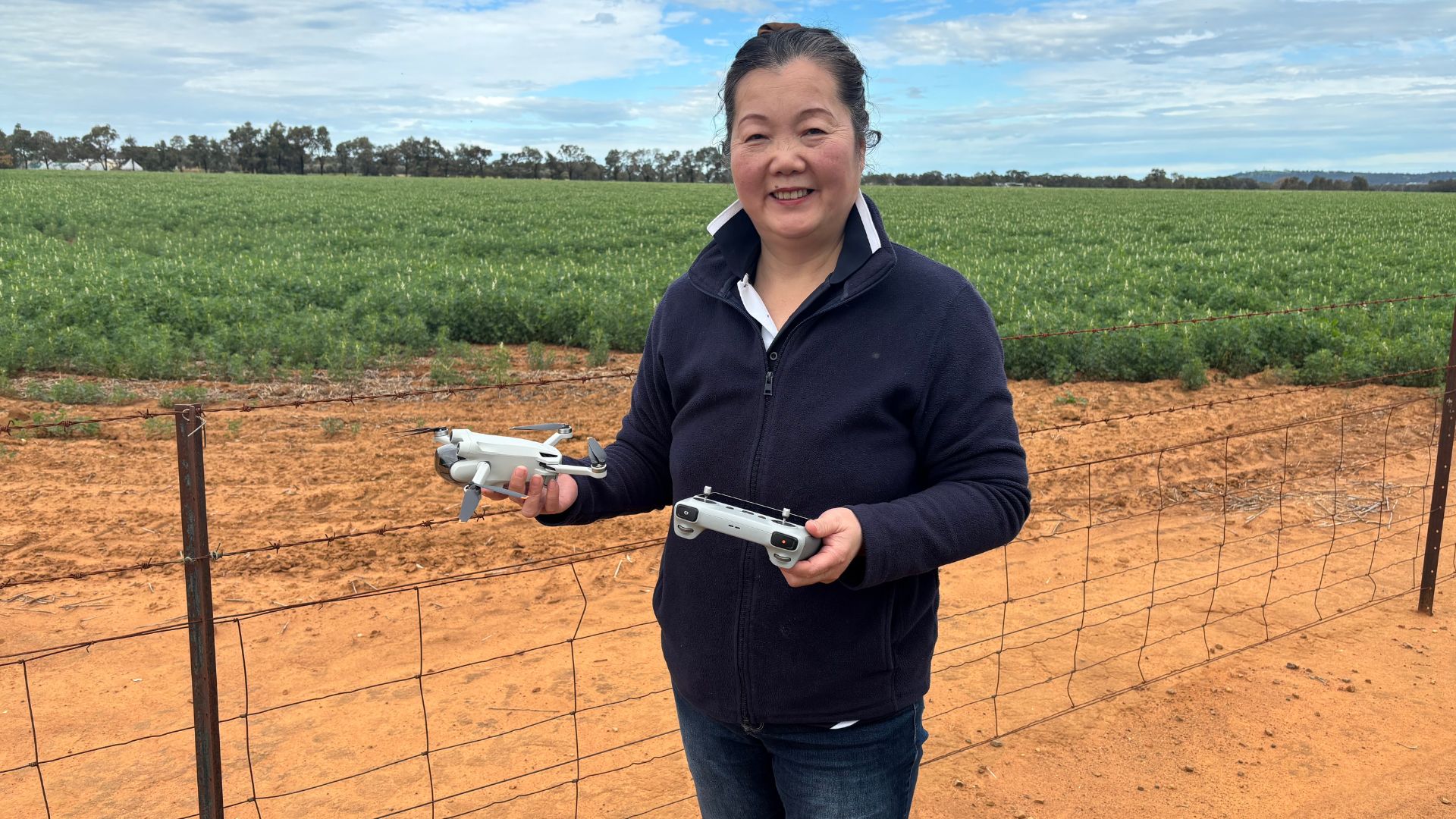
- Charles Sturt researchers develop AI-powered drone technology, called SkyEye, for crop monitoring
- The technology will help monitor crop distress, weeds, pests and irrigation risks to improve productivity and identify risks
Charles Sturt University researchers have developed artificial intelligence (AI) technology that could assist Australia’s 80,000 farming enterprises which face challenges in monitoring and managing their assets in real time.
An AI-powered drone, called SkyEye, performs crop and livestock inspections which are analysed by AI to detect crop stress, weeds, pests and irrigation risks.
Professor in Computing in the Charles Sturt School of Computing, Mathematics and Engineering Lihong Zheng in Wagga Wagga got the idea for SkyEye while working on another research project for the former federal Department of Agriculture, Water and Environment.
"Many farms are too vast to inspect by hand. One farmer may manage thousands of hectares and checking it all costs time and fuel," Professor Zheng said.
"Data helps but it is often too delayed or scattered to act on. That is where SkyEye comes in."
SkyEye’s AI technology analyses video and images captured by the drone for soil fertitlity and moisture levels, pest and disease detection and livestock tracking.
The AI tool detects patterns and relationships in the imagery and makes recommendations to farmers, including how they can optimise the use of fertilisers and pesticides, predict yield and monitor livestock wellbeing.
SkyEye can provide live alerts and insights through an easy-to-use dashboard to help farmers make timely decisions.
Professor Zheng said SkyEye could have wide applications across Australia’s agriculture industry, which is set to make more than $100 billion this year through livestock, broadacre cropping and horticulture.
"SkyEye helps farmers make informed decisions,” Professor Zheng said
“It can optimise the use of water, fertilisers, pesticides, fuel and labour, reduce operational costs, improve productivity, and identify issues early to maximise yields.”
Professor Zheng noticed gaps in the monitoring system and started working on SkyEye with Dr Jian Liu from the Charles Sturt AI and Cyber Futures Centre, PhD graduate Dr Rabin Dulal and PhD student Mr Wengfend Jia.
The research was recently part of CSIRO's ON Prime, a nine-week program that enables researchers to refine problems through 102 interviews of farmers, agnomists, counsulting agencies, agbusiness, industry and academics, and take their research to market.


Social
Explore the world of social