
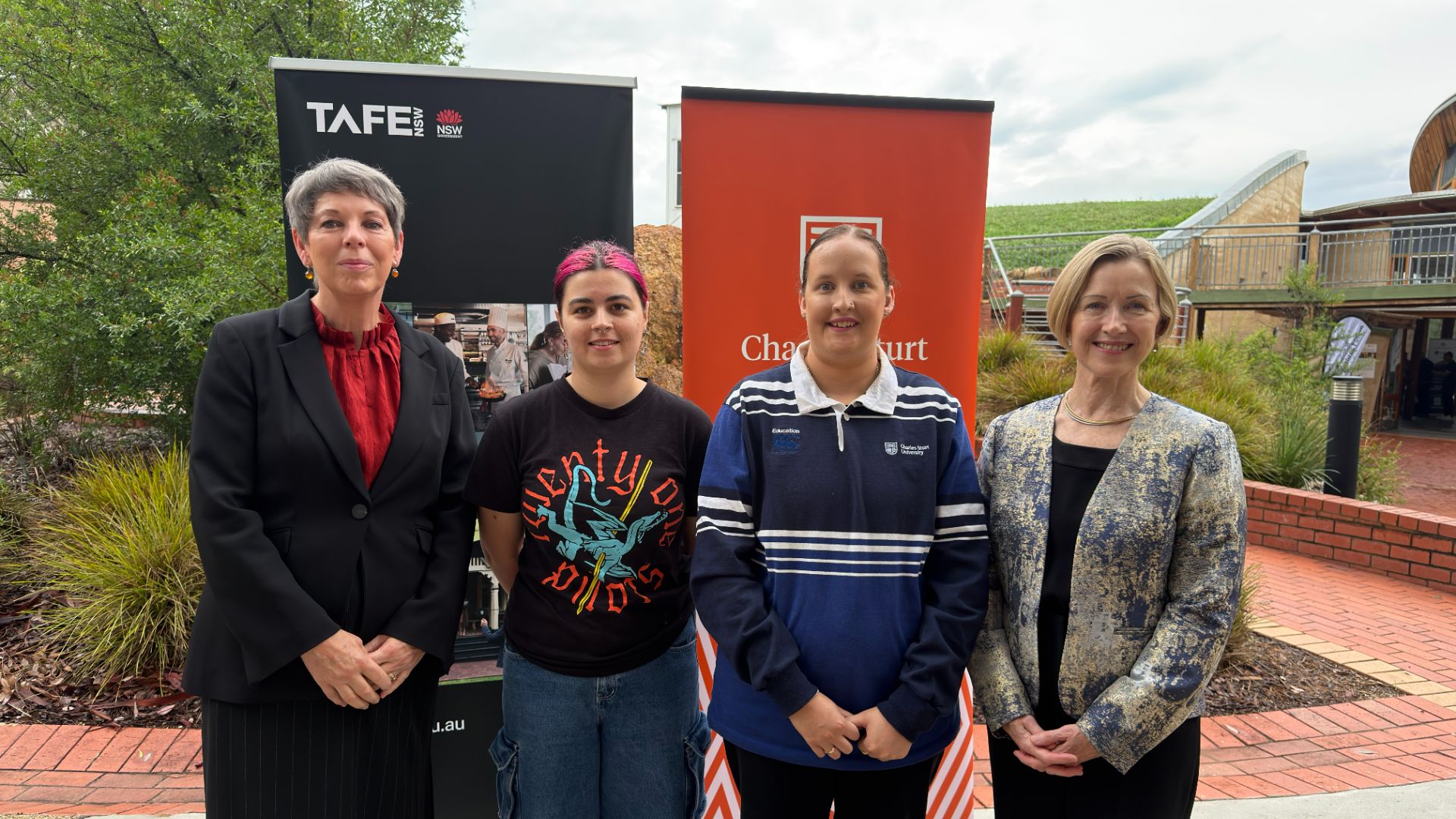
- New Connected Pathways Program delivers seamless, fully supported VET-to-degree transitions for students
- Charles Sturt and TAFE NSW join forces to widen student pipelines into essential regional workforce roles – more teachers, nurses and mental health workers
- Program expands Charles Sturt’s proven VET pathways, accelerating students into health, education, community services and other degrees
Charles Sturt University and TAFE NSW have today announced the launch of their joint Connected Pathways Program, a statewide initiative which makes VET‑to‑degree study seamless, supported and strongly connected to regional workforce needs.
The program represents an innovative model of regional university‑Vocational Education and Training (VET) collaboration, combining Commonwealth and State Government-supported Fee Free TAFE qualifications at TAFE NSW and a $2.1 million investment by Charles Sturt, which includes new funding via the Commonwealth Government’s Needs-Based-Funding scheme.
The Connected Pathways Program delivers dedicated student support: coordinated admissions processes, advice for students from both TAFE NSW and Charles Sturt, transition scholarships, assessment‑literacy coaching and regional work placement opportunities through Charles Sturt’s extensive industry partnerships.
For First Nations students, the partnership will include jointly designed and culturally appropriate entry programs, as well as coordinated support through scholarships, one-to-one tutoring and networking with other Aboriginal students and alumni.
The joint supports and opportunities will ensure that students are set up for success across their TAFE NSW to Charles Sturt learning journey and can move towards their career goals with greater confidence.
Students who complete an identified Fee Free TAFE Diploma at TAFE NSW can receive credit towards their Charles Sturt degree, allowing them to complete their university course faster and with less cost.
For example, a student who completed a TAFE NSW Diploma of Nursing (with AHPRA registration) will receive one year credit towards Charles Sturt’s Bachelor of Nursing, allowing them to finish that course with two years of full-time study, not three, and reducing the overall course costs by up to $10,000.
Charles Sturt University Vice‑Chancellor Professor Renée Leon said the Connected Pathways Program reflects the University’s commitment to investing in practical, student‑centred solutions.
“This partnership is about putting real investment behind the promise of pathways through dedicated transition advisors, joint onboarding and tailored supports that help VET students thrive at university from day one,” Professor Leon said.
“By collaborating with TAFE NSW, we will meet students where they are and walk with them through university study and into rewarding careers.
“I thank TAFE NSW for the shared commitment to practical solutions that put students and regional communities first.”
TAFE NSW Managing Director Chloe Read said the partnership will give students in regional communities clearer, more supported pathways into tertiary education and the skills they need to get ahead.
“This partnership between TAFE NSW and Charles Sturt University is really exciting because it focuses on regional students and communities, where workforce and critical skills shortages in essential sectors like health and early childhood education can hit harder than in metro centres.
“The Connected Pathways Program will do exactly what it says on the tin – create closer connections across VET and university education for more flexible student pathways to critical skills qualifications.
“We’re leveraging support services, facilities and expertise from both TAFE NSW and Chares Sturt to create a more joined-up tertiary sector to benefit everyone – students, employers and communities.”
The NSW Minister for Skills, TAFE and Tertiary Education, Steve Whan, said the partnership has been developed with regional communities and local needs in mind.
“Giving people more flexible pathways to education and earning qualifications for employment is a priority for every level of government and is an important part of the solution to skills shortages and the needs of local communities.
“Supporting students to move seamlessly between providers, recognition of prior learning and credit transfers make the system more efficient, helping governments respond quickly to shortages by enabling workers to progress to higher‑value qualifications without delays.
“The TAFE NSW and Charles Sturt partnership is a practical application of the NSW Government’s Higher Education Strategy, which works to build a more accessible, equitable and future-focused tertiary system – one that expands opportunity, supports under-represented learners, and delivers the skilled workforce Australia needs.”
The Australian Government’s Minister for Education, The Hon Jason Clare MP, supports the Connected Pathways Program.
“We need more doctors, teachers, nurses and social workers. And we need more of them in regional and rural areas,” he said.
“This will help more people in regional and rural areas to get the skills and qualifications they need, quicker and cheaper.”
Charles Sturt enters this program from a position of national leadership in integrated VET pathways into higher education.
In 2025, more than 4,500 Charles Sturt students received credit based on their previous VET study. These students were at different stages of their education journey, with 3,113 entering via diploma or advanced diploma qualifications and 1,281 via certificate pathways.
These students are studying in fields critical to regional workforce supply, including:
- 867 students entering from the Diploma of Nursing
- 817 from the Diploma of Early Childhood Education and Care
- 100 from the Diploma of Community Services
Professor Leon said that with more than 80 per cent of Charles Sturt’s regional students going on to live and work in regional Australia after graduation, the Connected Pathways Program would help address regional Australia’s skills crisis.
“Two of Charles Sturt’s core missions are growing access to higher education and the provision of the skilled workforce that regional Australia needs,” Professor Leon said.
“The Connected Pathways Program aligns these two goals by allowing students already embedded in regional communities to use their VET qualifications to progress into and succeed at university, and from there into impactful careers in regional towns, cities and communities.
“Health, education and community services are where regional skills shortages bite hardest. This program turns pathways into pipelines so students succeed sooner and communities get the skilled professionals they need.”




Social
Explore the world of social