
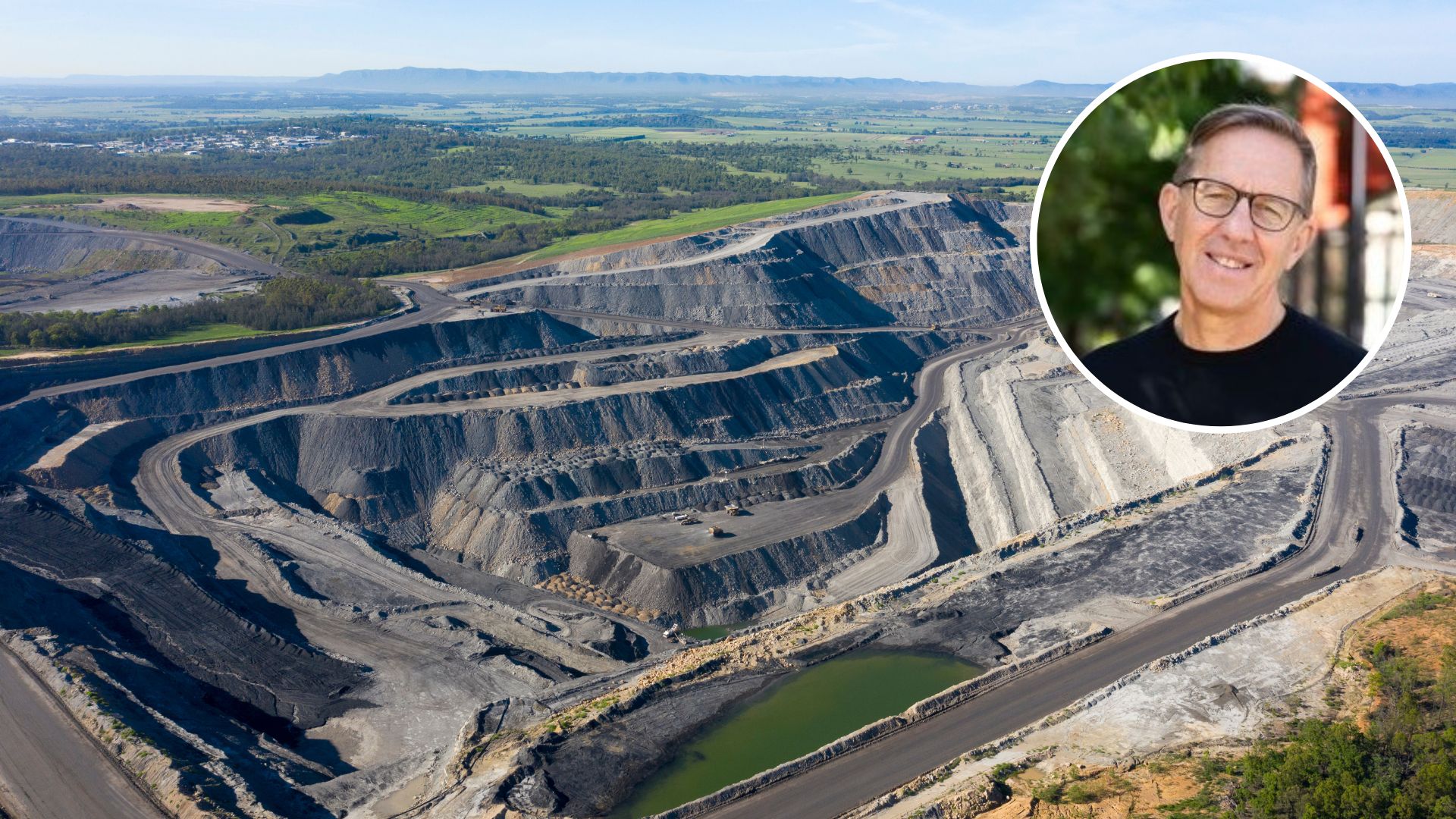
- A Charles Sturt University research project will investigate practical ways to strengthen how NSW manages the costs and responsibilities of mine rehabilitation after mining operations cease
- NSW has hundreds of active mine sites subject to rehabilitation obligations and hundreds of abandoned mines that continue to require management and remediation
A Charles Sturt University research project aimed at protecting the environment and taxpayers from the long-term impacts of abandoned and underfunded mine rehabilitation has received support through a prestigious national policy research grant.
The research is led by Dr Simon Wright (pictured inset), Senior Research Fellow (Energy and Circularity) in the Charles Sturt Gulbali Institute for Agriculture, Water and Environment.
The project, Unfunded and Uninsured: A Policy Framework and Rehabilitation Fund for Post-Mining Liability in NSW, will investigate practical ways to strengthen how NSW manages the costs and responsibilities of mine rehabilitation after mining operations cease.
Poorly rehabilitated and abandoned mines can leave polluted waterways, contaminated land, damaged ecosystems and ongoing public safety risks, while the costs of rehabilitation can ultimately fall on taxpayers if adequate funding and governance arrangements are not in place.
The project will examine funding and governance models used across Australia and internationally to identify practical solutions that could help reduce these risks in NSW.
The research aims to help governments develop stronger policies to address unfunded mine rehabilitation liabilities and prevent future costs from falling on taxpayers.
It will also contribute to broader policy discussions about balancing economic development with long-term environmental responsibility.
Mining is worth approximately $383 billion to Australia in annual exports and about $22 billion a year to the NSW economy.
NSW has hundreds of active mine sites subject to rehabilitation obligations and hundreds of abandoned mines that continue to require management and remediation.
Dr Wright said his research aims to identify policies that can reduce future rehabilitation liabilities.
“Mining has played an important role in Australia’s economy but some sites can leave behind environmental and financial challenges if rehabilitation is not fully funded or completed,” he said.
“When this happens, communities and governments can face significant costs for restoring land, managing pollution and ensuring former mine sites are safe for future use.”
Deputy Vice-Chancellor (Research) Professor Neena Mitter congratulated Dr Wright for the successful grant application and said this research is vital to informing future rehabilitation as an integral component in the lifecycle of mines.
“This research has significant implications for state and national mining policy and implementation, and could have applications in international mine management as well,” Professor Mitter said.
“The University is proud to advance research such as this that drives policy outcomes that improve lives and communities particularly in rural and regional Australia.”
The project is one of nine research initiatives selected for funding through the Australian Public Policy Institute’s 2026 Policy Challenge Grants program, which supports university-led research addressing key public policy challenges facing Australia.
Researchers collaborating on the project include representatives from Macquarie University, Hunter Renewal, Hunter Jobs Alliance, Western Sydney University and Yarrawalk.



Social
Explore the world of social