
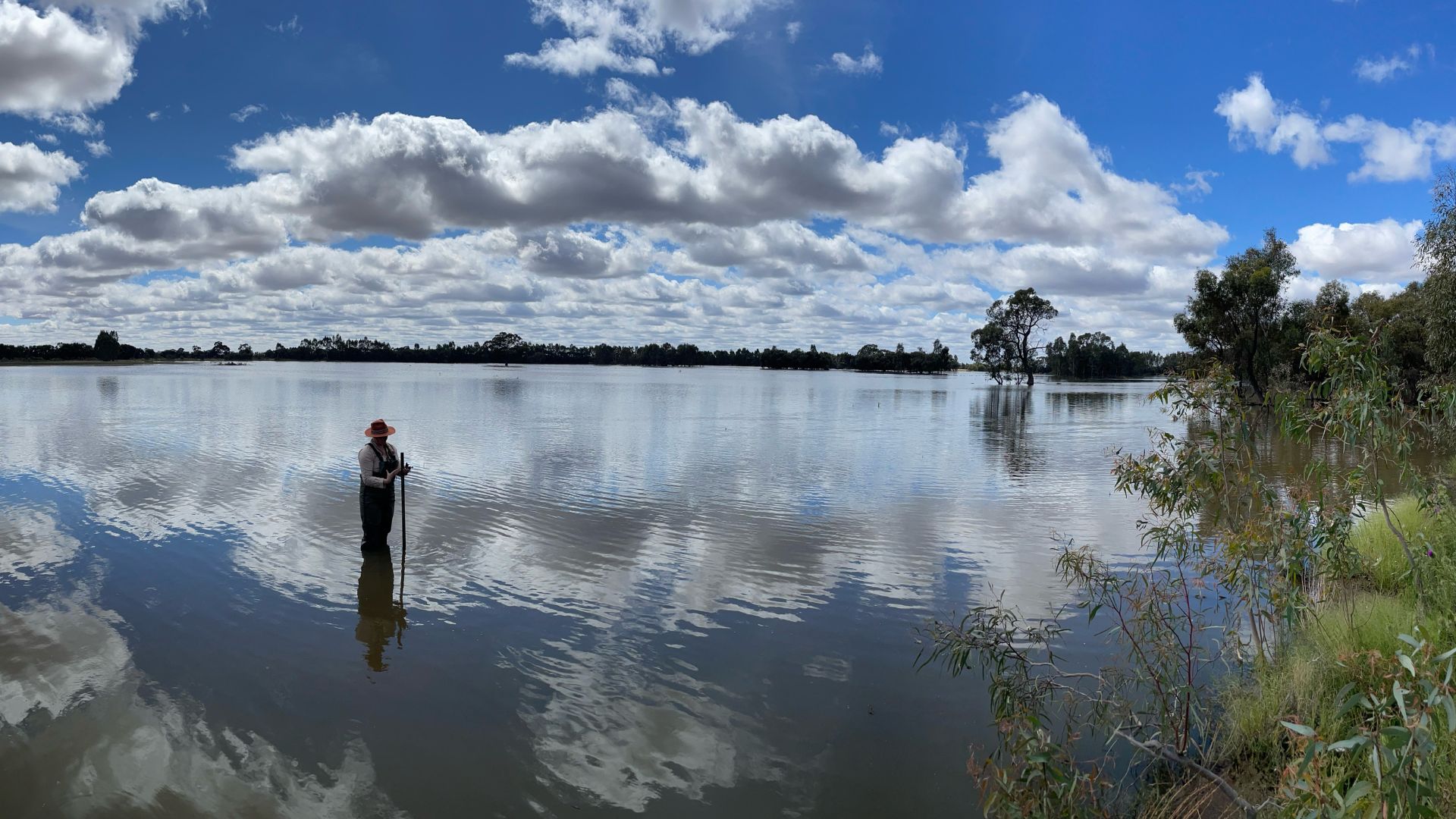
- New research records sights and sounds of a wetland near Balranald over a four-month period to offers new way to experience inland wetland
- The project seeks to enhance public engagement with Australian wetland ecosystems to raise awareness of their importance and threats
New research is showing how digital storytelling can foster connection with Australia’s wetland ecosystems and how digital media plays a role in raising awareness of the country’s ecological issues.
The lives of wildlife in a wetland near Balranald in the Riverina have been turned into a digital project, beautifully capturing the sights and sounds of one of the Murray-Darling Basin’s most diverse ecosystems.
A collaboration between Charles Sturt University and Australian National University researchers has resulted in the creation of Mosaic - a rich portrait of an inland wetland made of sound, images and videos filmed over four months.
Mosaic celebrates wetland wildlife, acknowledges the problem of invasive species and shows how landholders and government agencies are working together to care for these places.
Ecologist with Charles Sturt’s Gulbali Institute for Agriculture, Water and Environment and project lead for the Murrumbidgee Monitoring Evaluation and Research (Flow-MER) Program Professor Skye Wassens lead the research team.
The team set up cameras around the wetland and recorded sounds and footage to identify what wildlife was present at different times.
Professor Wassens said Mosaic aims to enhance public engagement with Australian wetland ecosystems and raise awareness of the value of water for the environment.
“Mosaic brings together cutting-edge science, local knowledge and practical conservation work in an innovative digital experience designed to connect the public with Australia’s inland wetlands,” she said.
“Inland wetlands and waterways face multiple challenges, but stories of decline and disaster risk further disengaging the public.”
Professor Mitchell Whitelaw, of the ANU School of Art and Design, led the design of Mosaic.
Professor Whitelaw said as the project’s name suggests, Mosaic assembles thousands of digital pieces to make a new picture.
“By using multiple motion-triggered and time-lapse cameras with continuous audio, and combining this media in custom-made interfaces, we can show what’s happening on the wetland in new ways,” he said.
“We also aimed to support different kinds of experience for visitors. So, you can scroll through a guided tour, actively investigate, explore and share your discoveries, or just sit and listen to the wetland soundscape.”
The result is an insight into a living ecosystem, which highlights how animals depend on wetland environments while recognising the presence of invasive species, such as foxes and pigs.
According to the NSW Government’s 2024 State of the Environment Rivers and Wetlands report, there are more than 20,000 wetlands across NSW, covering about 4.5 million hectares or about 6 per cent of the state. Of these, 67 are protected under the Ramsar Convention - and international treaty adopted in 1971, which provides framework for the conservation and sustainble use of wetlands.
The condition of many wetlands across Australia has deteriorated due to increased water regulation, the expansion agriculture and urban and industrial expansion.
The project serves as an accessible educational resource for schools, community groups and the broader public and, according to Professor Wassens, will have benefits for landholders, researchers, environmental managers and policy makers. is adamant Mosaic
“Mosaic recognises and showcases the important role landholders play in restoring and managing wetlands, which may encourage broader adoption of conservation and restoration practices,” Professor Wassens said.
“Mosaic helps translate complex environmental monitoring data into engaging and accessible stories, which build public understanding and support for environmental water programs.”
Scientists from Charles Sturt University’s Murrumbidgee Area Project Flow-MER team and the Australian National University have worked closely with the Morton family, who have led the restoration of the wetland.
The findings of Mosaic are now available to view online.


Social
Explore the world of social