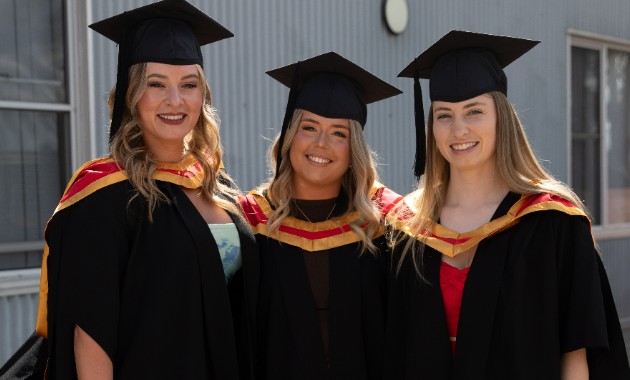
Charles Sturt University has celebrated a landmark moment in regional Australian healthcare, with the first cohort of students completing the Joint Program in Medicine delivered in partnership with Western Sydney University.
The milestone comes as Charles Sturt announces accreditation from the Australian Medical Council to deliver the Doctor of Medicine program independently from 2026, cementing its role as one of the few regional universities in Australia to train doctors from start to finish.
Last week it was announced the University will receive an additional 10 Commonwealth-Supported Places each year for students in the Doctor of Medicine course.
The Joint Program in Medicine was established to tackle Australia’s regional health crisis. Regional, rural and remote communities face chronic shortages of healthcare professionals, leading to poorer health outcomes, higher rates of preventable hospitalisations and reduced life expectancy compared to metropolitan centres.
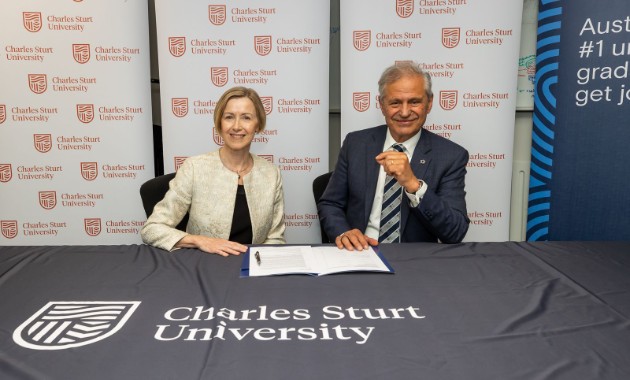
Charles Sturt Vice-Chancellor Professor Renée Leon said the program was designed as a social contract with regional Australia to help address these issues and inequities.
“For too long, regional Australians have endured inequitable access to healthcare,” she said.
“By training doctors in regional settings, we are embedding them in the communities where they are most needed. This is not just an academic initiative—it is a promise to deliver better health outcomes for regional Australians.
“I congratulate our first cohort on their success in completing their studies and wish them all the best as they move into the healthcare workforce.”
Among the first cohort is Cameron Martin, a proud First Nations student who has accepted a job as a junior doctor in Tamworth, starting next year.
Mr Martin and his classmates spent the last three years in clinical settings across regional New South Wales, completing thousands of hours of placements.
This followed their first two years studying in state-of-the-art facilities at the University’s Orange campus.
“Studying medicine in a regional setting has shown me the difference doctors can make in building trust and inclusivity in healthcare,” Mr Martin said.
“We are not just learning medicine—we are learning how to serve communities that need us most.
“Being part of the first cohort is a privilege. I hope many more students from regional backgrounds will follow in our footsteps.”
The Joint Program in Medicine has been co-delivered with Western Sydney University. Together, the universities designed a curriculum that is rigorous, innovative and responsive to regional needs.
Western Sydney University Vice‑Chancellor and President, Distinguished Professor George Williams AO praised the collaboration.
“This partnership has been a model of what can be achieved when universities unite around a common purpose,” Professor Williams said.
“Together we have shown that collaboration, rather than competition, is the key to solving the great challenges of our time.
“We are proud to have worked alongside Charles Sturt to lay the foundation for this program. While Charles Sturt will now carry it forward independently, our collaboration in research, placements and broader health initiatives will continue.
Charles Sturt University has now been accredited to deliver the Doctor of Medicine program independently from 2026.
This achievement reflects the strength of its academic staff, the quality of its facilities and the commitment of its communities.
Professor Leon said the accreditation was a defining moment for the University and regional Australia.
“Charles Sturt will stand as one of the few regional universities with the authority to train doctors from start to finish,” she said.
“This independence allows us to expand places, deepen our regional focus and strengthen our contribution to Australia’s health workforce.
“It is a testament to the vision and dedication of our staff, students and partners. We are proud to carry this program forward as a regional university committed to serving regional communities.”
Member for Calare, Mr Andrew Gee, a longtime advocate for the School of Rural Medicine, said the milestone of the first cohort’s completion was a victory for regional Australia.
“Our communities fought so passionately for the establishment of this medical school because we see every day the devastating impact of the rural doctor shortage crisis,” Mr Gee said.
“We’re incredibly proud of the class of 2025 and look forward to the critical contribution they will make to country medicine and the lives of country people.
“The very first class of graduates completing their medical degrees is certainly something to celebrate but it’s also a reminder that there is still more work to be done in securing more Commonwealth-funded medical student places.”
The recent allocation of 10 additional CSPs means that from next year the course will have 47 CSPs, dramatically increasing its ability to address critical doctor shortages across regional, rural and remote communities.
These additional places mean more students will study medicine in regional Australia and, importantly, more doctors will work in regional communities when they graduate.


Social
Explore the world of social