
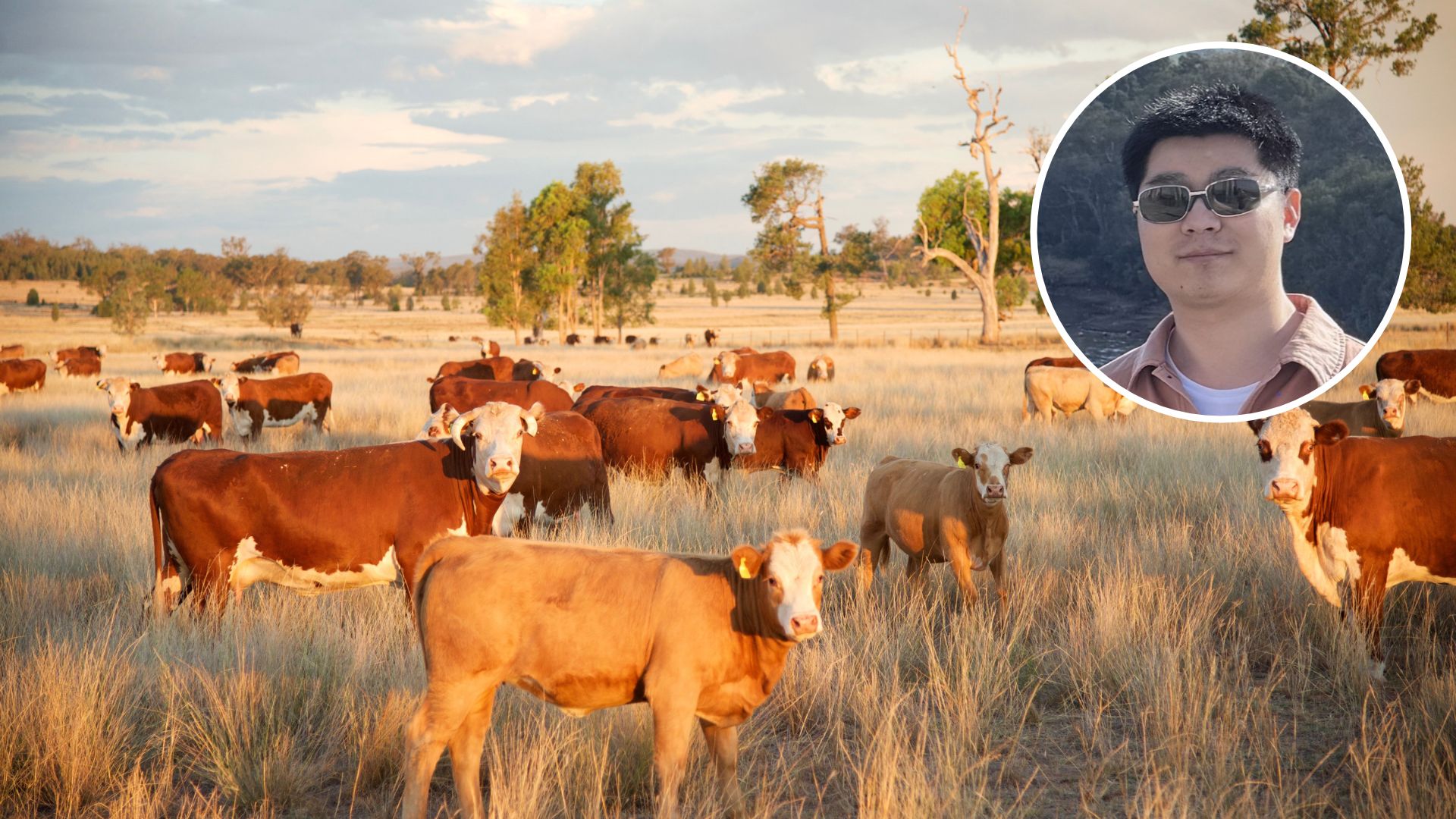
- Charles Sturt University researchers hope to apply emerging technologies to real-world agricultural problems
- Remote weighing can help producers monitor animal performance more frequently, reduce unnecessary handling, and support decisions around feeding
Research by a Charles Sturt University PhD student and his academic colleagues has the potential to enable accurate remote estimation of cattle weight, with applications to all livestock.
Third-year PhD candidate Mr Wenfeng Jia (pictured, inset) at Charles Sturt University in Wagga Wagga is a member of a team who say an important motivation for them is to see whether the rapid advances in AI and 3D modelling can be translated into tools that are genuinely useful in agriculture.
“This research has the potential to reduce the time, labour and safety risks associated with collecting animal weight data, while providing producers with information that can support grazing management, animal performance monitoring and livestock marketing decisions,” Mr Jia said.
“Our team is exploring how recent advances in AI and 3D modelling can be used to estimate cattle weight without requiring animals to step onto a conventional weighing system.
“The project uses ordinary Red Green Blue (RGB) cameras to capture cattle from multiple viewpoints, and an AI-based multi-view 3D reconstruction method is then used to build a 3D representation of the animal.
“From this, body size, shape and other geometric information can be used to accurately estimate weight.”
The Australian Bureau of Statistics last year estimated there are approximately 29.7 million cattle and 65.8 million sheep in Australia, worth approximately $28.4 billion to the national economy.
One of the researchers’ key goals is to provide a potentially lower-cost and less intrusive alternative to methods that rely on more expensive sensors.
“In the future, this kind of technology could help livestock producers monitor animal performance more frequently, reduce unnecessary handling, and support decisions around feeding, drafting and sale readiness,” he said.
Charles Sturt Deputy Vice-Chancellor (Research) Professor Neena Mitter congratulated Mr Jia and the team, complimenting them on the significant potential of this research.
“This is an excellent example of the practical and impactful research the University can contribute to national and international agriculture,” Professor Mitter said.
“The remote cattle liveweight estimation research has the potential to improve livestock production, save time and reduce producers’ costs by supporting grazing management, animal performance monitoring and livestock marketing.”
The project has been a team effort, Mr Jia said, and he was very grateful for the collaboration and support from the team: Dr Rabin Dulal, Professor Lihong Zheng in the Charles Sturt School of Computing, Mathematics and Engineering and Professor Jane Quinn in the School of Agricultural, Environmental and Veterinary Sciences and the Charles Sturt Gulbali Institute for Agriculture, Water and Environment.
Mr Jia has been selected as a recipient of a South Australian Livestock Research Council (SALRC) AgTech Student Innovation Competition Scholarship, and has been invited to attend the 2026 Livestock Conference in Wagga Wagga (21-22 October) and deliver a five-minute presentation that provides an overview of his research.
“Receiving the scholarship is fantastic, and it is great recognition of the work our team has put into the project,” he said.
“It is also a valuable opportunity to share the research with industry and learn more about how the technology could be applied in practice.
“We hope the project can continue to develop and be validated in more real-world settings so that it can eventually provide genuine value to the livestock and agricultural sectors.”


Social
Explore the world of social