
- A Charles Sturt University agricultural researcher raised in Sri Lanka advocates for Australia’s need for a coordinated national framework to guide agricultural innovations
- Australia’s total agricultural production value is projected to hit a record $101.4 billion (or up to $107.4 billion including fisheries and forestry) in 2025–26
A Charles Sturt University agricultural scientist and applied microbiologist highlights the need to change the way Australia farms.
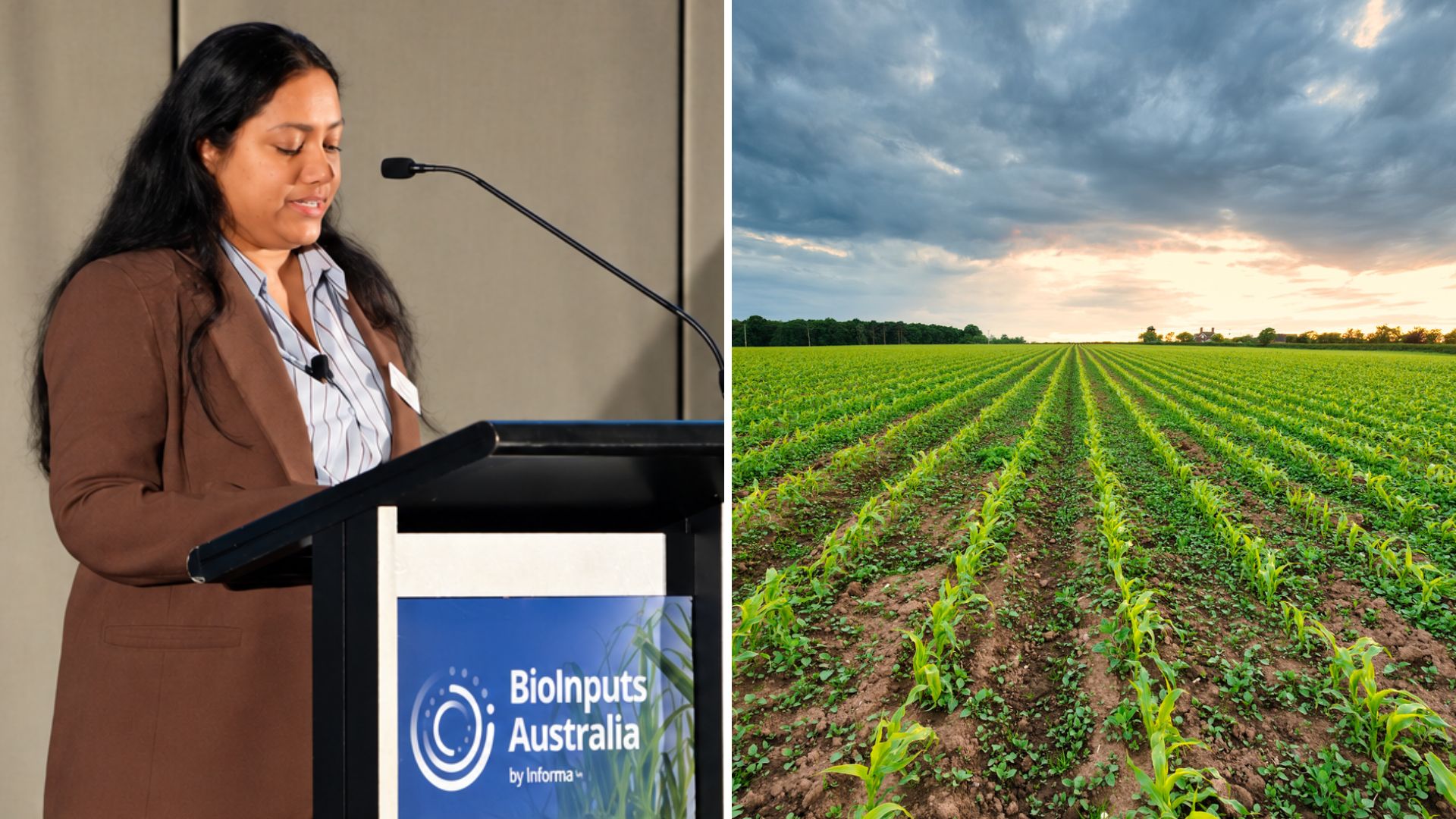
Speaking ahead of National Agriculture Day 2026 on Friday 20 November, Postdoctoral Research Fellow at Charles Sturt Gulbali Institute for Agriculture, Water and Environment, Dr Nirodha Weeraratne (pictured top) cautions that a shift away from conventional agriculture is essential.
There are several reasons for this, including the uncertainty around the availability of petrochemical-based inputs from the Middle East, which has raised the cost of conventional fertilisers and crop protectors.
“The conventional ways of farming can’t continue, as the ratio of arable land to global food demand diminishes and current farming practices will struggle to keep pace,” Nirodha said.
“This will increase food production costs and threaten food security worldwide, strengthening the
case to remove our reliance on petrochemicals and explore biological alternatives.”
Nirodha said Australia needs a coordinated national framework to help guide agricultural innovations from laboratory to farm.
“We need to find more efficient ways of validating agricultural products at the laboratory level, in research field trials, and on-farm," she said.
“Then we need to help with their adoption, because there is currently a lack of understanding about the different biological inputs across the agriculture sector.
“We need to develop adoption programs to educate everyone - from agronomists to regulatory and policy decision makers – about the science behind biological inputs.”
Australia’s total agricultural production value is projected to hit a record $101.4 billion (or up to $107.4 billion including fisheries and forestry) in 2025–26, according to the National Farmers’ Federation.
Humbly, Nirodha describes herself as ‘an average learner interested in agriculture’, now contributing to national agriculture research and teaching in Australia.
Nirodha’s interest in agriculture grew from being raised in a farming village in Sri Lanka, with no electricity, running water, and cars. Her father was a farm leader, of sorts, for their community, piloting new crops and farming practices, and later was the first villager to get a ute.
Her mother was a teacher and she pushed Nirodha to strive for further education.
“Our village relied a lot on various international aid agencies including AusAid to support their livelihood, farming,and water supply,” she said.
“This gave me motivation to study agricultural sciences with an aim of stregthening global food security, which led me to work in Australia and now, coming full circle, to do research here which will also help international agricultural production including farming systems in Sri Lanka.”
Nirodha was recently invited to help convene Australia’s first conference dedicated solely to biological inputs in agriculture, BioInputs Australia 2026, which was held in Melbourne in October with more than 150 participants.
She chaired the first day sessions focused on biological inputs Research and Development (R&D), delivered a presentation on ‘Novel frontiers of plant biostimulant R&D’, and moderated the panel discussion on ‘Advancing biological inputs: research priorities and industry collaboration’.
The event was sponsored by major agricultural industry companies and organisations, including the Charles Sturt University Agrisciences Research and Business Park (AgriPark).
Nirodha said dozens of new agricultural biological products are developed every year but no single product meets all needs, so Australian farmers will need a mix of solutions to address this complex and evolving challenge.
She said there are three main categories of biological products based on what they are used for in agriculture.
“In the first category are biofertilisers, and then biostimulants, which don’t have any direct nutritional application but can improve the plant’s resilience to environmental conditions,” she said.
“Next are biocontrol agents, biopesticides, and biorationals that tackle pests, diseases and weeds, and ensure optimum crop growth and production.
“Lastly, probiotics which help the growth and performance of livestock, and some of which can be applied to plants as well.”
Nirodha said each of these options could play an important role in bolstering national food supply, but their influence on both human and environmental health must be factored in.
“We need to understand and answer with confidence, ‘can we safely consume this product, and, is it good for the environment?’,” she said.
“There is no black and white solution, but there is evidence for an integrated approach.”
Nirodha said in the last 70 years, Australia has introduced various biological products to its farms - most notably Rhizobium inocula for legumes, humates, and seaweed extracts – and now there is an increasing demand for products that can help capture and sequester carbon in soil.
“People are thinking of biological ways to capture more carbon in soil and use it as a reservoir to store atmospheric carbon on-farm. That frontier is still developing, and there is a lot of potential there,” she said.
“Equally, there is a push for biological alternatives to pesticides like paraquat, atrazine, and imidacloprid, products which have been banned in other countries.
“Public concern is mounting around residual chemicals from these and their risk to human health, so I certainly see a large appetite for any biological input which addresses this.”



Social
Explore the world of social