
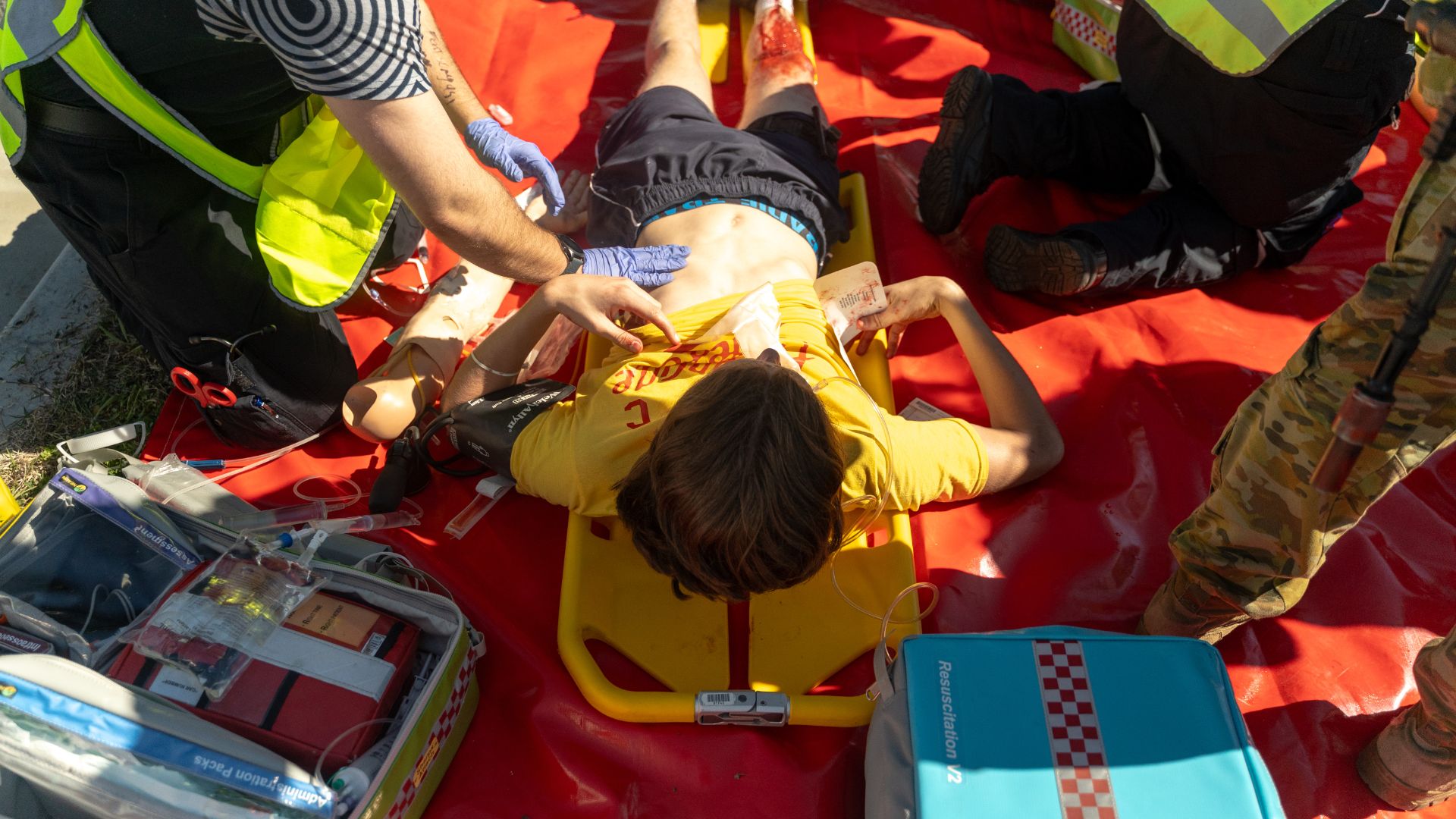
- Charles Sturt paramedicine, nursing and medical students are preparing for all eventualities in their future careers, including incidents with mass casualties
- Charles Sturt is partnering with some of Australia’s largest organisations to ensure emergency preparedness
A simulated riot on Bathurst’s streets with mass casualties has helped Charles Sturt University paramedicine, nursing and medical students prepare to handle the most stressful situations their careers might throw at them.
Approximately 180 students and 26 staff in the Charles Sturt School of Nursing, Paramedicine and Healthcare Sciences and the School of Rural Medicine teamed with up to 100 Army Reservists of the Australian Defence Force (ADF) to respond to a managed ‘riot’ simulation in Leena Street on Sunday 20 September.
As part of the exercise, approximately 14 armoured and light vehicles of the ADF’s 1st/15th Royal NSW Lancers and Army personnel carrying blank loaded weapons conducted activities around the Bathurst CBD, Mount Panorama, George Park and surrounding roads.
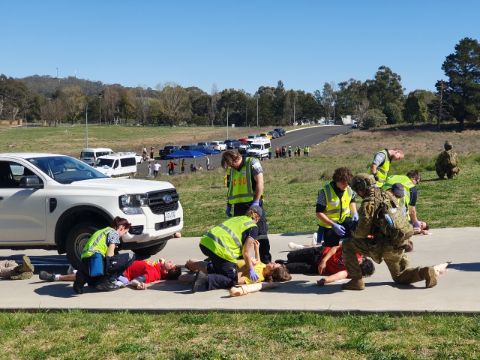 In that context, a scenario played out based around a non-violent protest group being hit by a vehicle of ‘an external actor’ (a counter-protestor or other issue-motivated individual).
This involved several ‘rioters’ (mannikins and actors) which Charles Sturt paramedicine, nursing and medical students then treated as ‘patients’ both at the site and after they were transported to the Clinical Simulation Centre on the campus.
The NSW Police Force (NSWPF) had an observing status due to operational commitments and were not directly involved.
Charles Sturt Acting Vice-Chancellor Professor Graham Brown said learning to effectively collaborate and communicate with Defence and Police personnel in an emergency situation is hugely beneficial for the University’s healthcare students.
“These situations and processes are taught in our courses but for our students to have the chance to put that therory into practice in an ultra-realistic environment is invaluable,” Professor Brown said.
“The Mass-X exercise was the perfect opportunity for our students to develop these skills, especially since they were working with some of Australia’s leading first responders in the Australian Defence Force and NSW Police Force.
“No one wants to see these types of situations happen in real life but, unfortunately, we know they do. It is comforting to know that when they do happen we will have paramedics, nurses and doctors who understand what’s needed.”
The exercise established a model for future Charles Sturt interdisciplinary simulation activities and enhances the University's reputation for innovative, simulation-based healthcare education.
Charles Sturt second-year paramedicine student Ms Krystal said participating in the Mass X event was both exciting and challenging, with many learning outcomes.
“The simulation enabled my fellow students and I to apply academic literacy and numeracy to assess, triage, and document patient care accurately,” Ms Jessup said.
“We had to demonstrate information and digital literacies using clinical technologies and communication tools and engage in interprofessional practice by integrating discipline-specific knowledge and skills in a dynamic, real-world scenario.
“We were required to uphold ethical and legal standards, ensuring culturally safe and socially just care, and reflect on our professional identity, understanding our role within the broader healthcare system and the importance of lifelong learning.”
Commanding Officer 1/15 RNSWL, Lieutenant Colonel Gregory Barter, said realistic training was essential to maintaining Defence preparedness.
“Exercises such as MENIN VIGIL are essential to ensuring our soldiers and commanders can operate effectively in challenging and dynamic environments,” LTCOL Barter said.
“Bathurst provides an outstanding training environment that allows us to conduct realistic activities while working closely with the local community and stakeholders.
“The men and women participating in this exercise are Army Reservists who live and work in communities across New South Wales. Training together in realistic conditions ensures they are prepared to contribute to Defence tasks whenever required.”


Social
Explore the world of social