
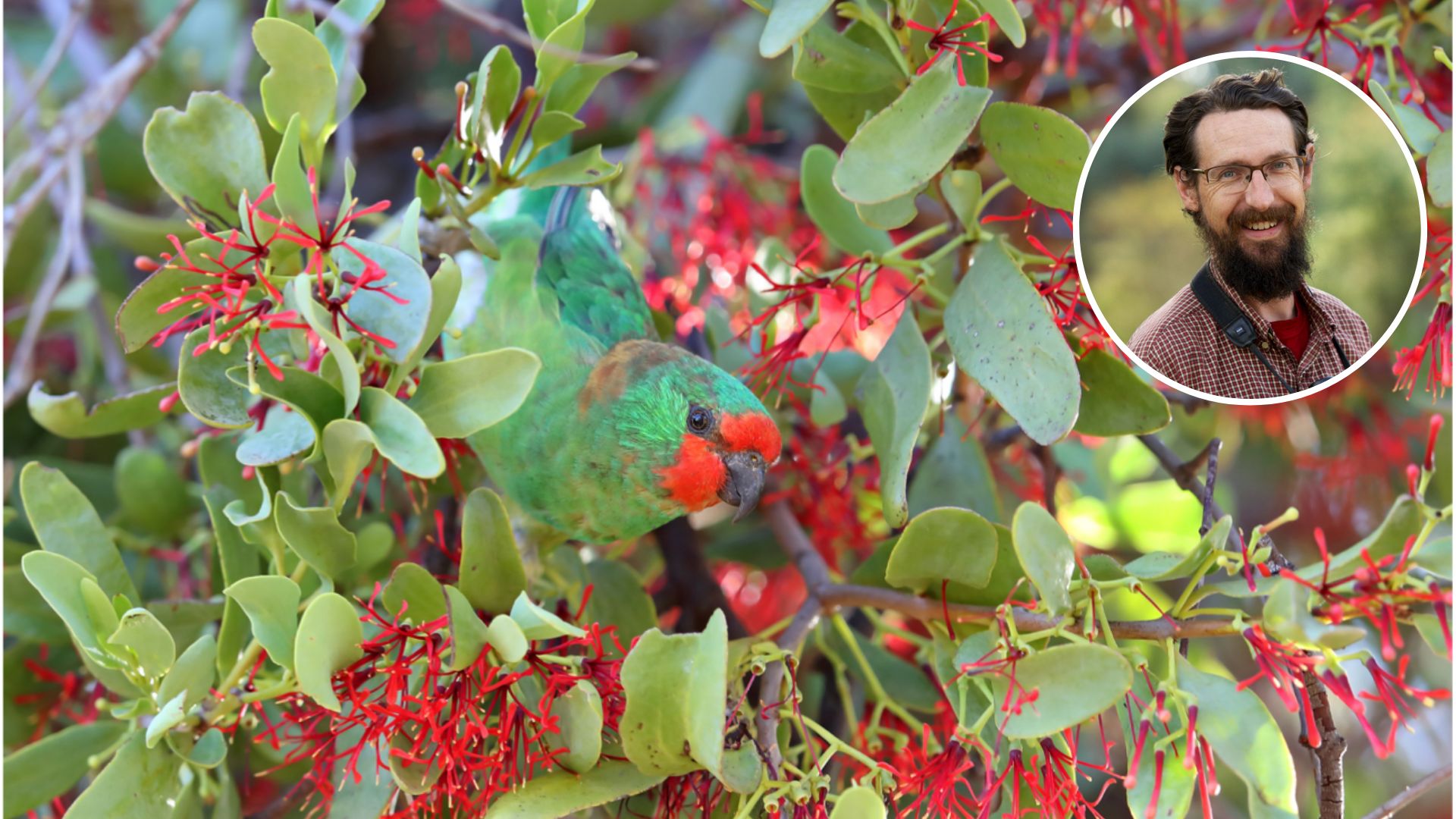
- Charles Sturt research shows how mistletoe species has helped songbirds develop
- The process has been 25 million years in the making, across the globe
- The research shows how they thrived and developed into new species
Research published in the international journal Oikos shows that the evolution of iconic mistletoe species has helped songbirds develop into the most diverse group of birds in the world.
According to the paper’s author, Professor David Watson (pictured, inset) with the Gulbali Institute for Agriculture, Water and Environment at Charles Sturt University, it is a long, complex story spanning 25 million years across the globe. Professor Watson is also a Professor in Ecology with the Charles Sturt School of Agricultural, Environmental and Veterinary Sciences in Albury-Wodonga.
Professor Watson has shown that early songbirds and mistletoes occurred in the same places and spread at the same time and it is no coincidence.
“Mistletoe relies on other plants for all their water and nutrition, so they have very particular needs when it comes time to disperse their seeds to new host plants,” Professor Watson said.
“Their sticky seeds come wrapped in nutritious fruit, encouraging animals to drop by for a snack then wipe off the seed onto another suitable host plant.”
Professor Watson previously demonstrated that the first mistletoes were dispersed by marsupials and early primates, which ate fruits from shrubs living beneath trees. They then transferred mistletoe seed up into the canopy where there was more light and fewer hungry mouths.
Modern mistletoes rely on songbirds to do this job – but where and when did this partnership start?
“The birds in question are the tyrant flycatchers and allies, the most diverse group of modern birds. They originated in Gondwanaland, which basically comprised Australia, Antarctica and South America,” Professor Watson said
“These ancient birds stepped off Antarctica into South America around 25 million years ago and have since evolved into more than 1,300 species, found right across the Americas, all the way up into Canada and across the Caribbean.”
By charting which species relied on mistletoe fruit for their food, Professor Watson revealed that birds found across eight of the ten families of these early songbirds exhibited this behaviour, and are exclusively found in the Americas.
“This includes five groups of mistletoe fruit specialists; they eat little else, feed the pulp to their chicks and even make their nests out of the sticky seeds,” he said.
Professor Watson notes there are only five other groups of birds that specialise in mistletoe fruit worldwide and contends that these South American groups all arose from one common ancestor.
“I have shown that this rare behaviour likely evolved just once in an early ancestor which passed the habit to its descendants,” he said.
“And, rather than a gradual process, this was really quick in evolutionary terms; this first group of songbirds radiated into 10 families of birds in less than five million years.
“The specialists we see today arose millions of years ago from fruit eaters with a broader diet that included mistletoe and became increasingly specialised over time. They diversified and changed their diets as they radiated into new habitats across the Americas, many becoming insect eaters in forest canopies.
“Even more remarkable is that before the spread of songbirds across the Americas, there were only five genera of mistletoe, represented today by 18 species. After the arrival of songbirds, 12 new genera arose, resulting in more than 360 mistletoe species across the continent, a 20-fold increase.
“So, as the first songbirds spread across South America, they brought mistletoes with them, both groups evolving rapidly into new species as they colonised new areas and found ways to thrive in entirely new habitats.
“We think of plant-animal interactions as partnerships we can observe and study today: ‘these animals eat those plants, these insects pollinate those flowers’. But ecological interactions don’t fossilise, so it can be very tricky to work out when they originated. For mistletoes and the birds that disperse them, this has been a 25 million year-long dance.”




Social
Explore the world of social